

Sales proposals and monthly fees are the wrong starting point for evaluating a professional employer organization. They show what a PEO wants to sell, not necessarily what the relationship will cost, who owns each compliance task, how service failures get corrected, or how difficult it will be to leave.
For HR directors, CFOs, and business owners at companies with 10 to 2,000 employees, the useful professional employer resources are decision tools. They expose total cost, risk allocation, service accountability, implementation effort, and exit economics before those issues become expensive surprises. A fee that looks attractive can lose its advantage through benefits markups, workers' compensation treatment, renewal increases, or internal transition work.
The eight resources below follow the PEO lifecycle. Start with cost modeling, compare finalists with a weighted scorecard, test contract and compliance exposure, then control workers' compensation, service delivery, implementation, and exit. Teams that need to process large volumes of HR documentation can also review AI for HR document parsing as a supporting operational resource, but automation won't replace ownership decisions.
Table of Contents
- 1. PEO Cost Comparison Spreadsheet Template
- 2. PEO Selection Scorecard and Evaluation Framework
- 3. PEO Contract Review Checklist
- 4. Multi-State Compliance Responsibility Matrix
- 5. Workers' Compensation Claims and Experience Modifier Analysis Report
- 6. HR Outsourcing Service Level Agreement Template
- 7. PEO Implementation and Transition Plan Template
- 8. PEO Exit and Transition Playbook
- 8-Point PEO Resource Comparison
- Turn the Resource List Into a Decision File
1. PEO Cost Comparison Spreadsheet Template
A cost model should answer a harder question than “What's the monthly fee?” It should show the fully loaded cost of each PEO over the period leadership cares about, including administrative fees, implementation charges, benefits markups, workers' compensation treatment, tax pass-throughs, service add-ons, and renewal language.
The spreadsheet should begin with consistent inputs for every finalist. Use employee count, industry classification, payroll volume, current benefits spend, worksite locations, and expected hiring patterns. Then build separate views for a 12-month comparison and a three-year projection, with optimistic, baseline, and pessimistic headcount scenarios. A percentage-based fee and a per-employee fee can look very different when payroll volume or headcount changes.
A 150-employee manufacturing company, for example, may discover that PEO A's 2% annual fee escalation clause adds $45,000 by year three, while PEO B offers a flat-rate agreement. That finding changes the negotiation from “Which quote is cheaper?” to “Which provider will accept a rate lock?”
Model internal cost, not just vendor cost
Implementation consumes HR, finance, payroll, and operations time. The model should record that internal effort as a real cost rather than treating it as free capacity. It should also include the cost of parallel systems, employee communications, benefits enrollment support, and post-cutover corrections.
A multi-state professional services firm might model HR compliance support as a PEO bundle and as a separate specialist service. In the scenario described, separating the compliance function produced an $18,000 annual saving. The correct decision depends on service quality and risk, but the spreadsheet makes the trade-off visible.
Practical rule: Request detailed fee schedules in writing before entering assumptions. Verbal explanations often leave renewal triggers and pass-through charges undefined.
For a deeper framework, use this PEO outsourcing cost analysis alongside the spreadsheet. It helps finance teams challenge headline pricing and focus on the economic terms that survive renewal.

2. PEO Selection Scorecard and Evaluation Framework
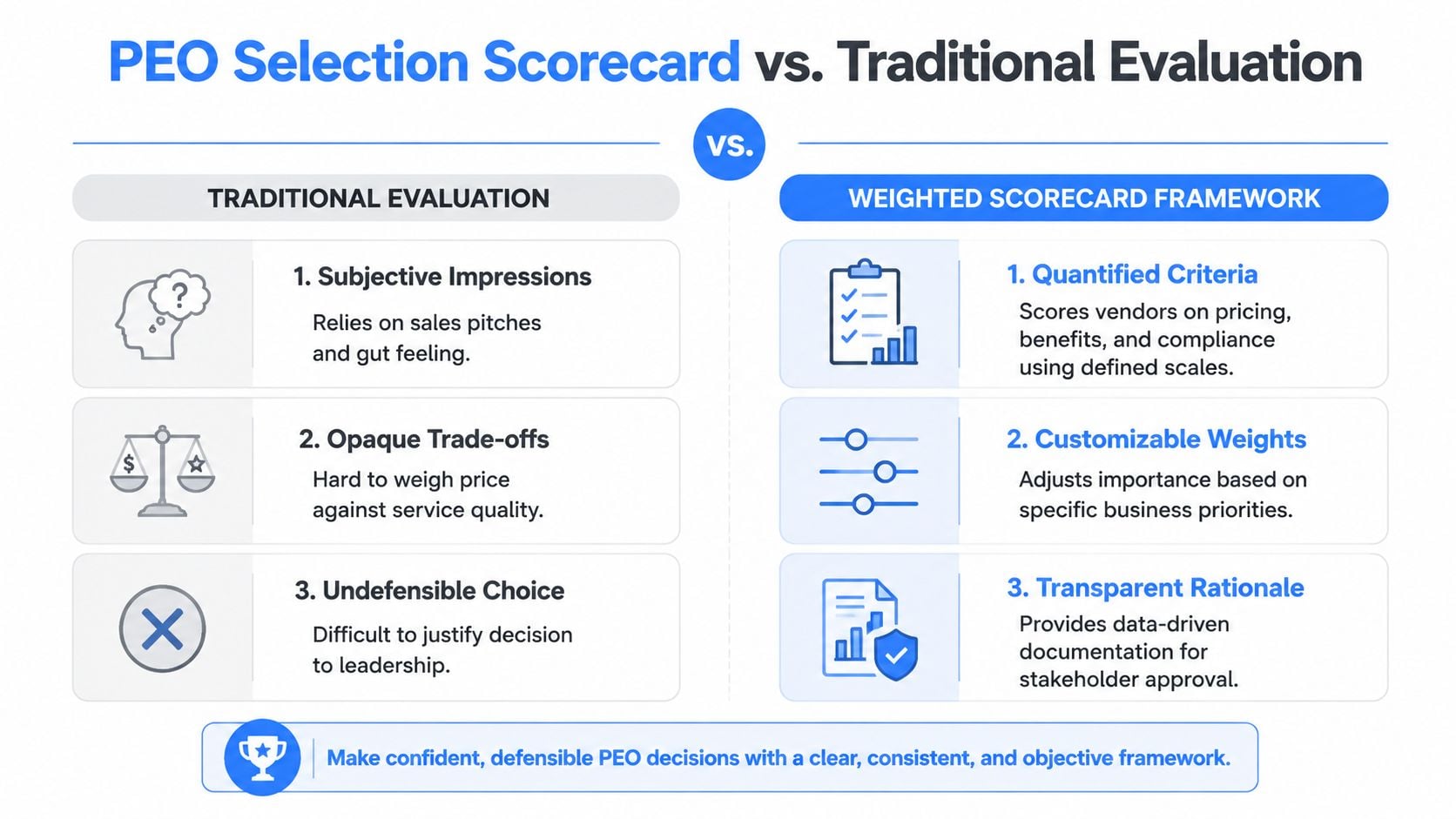
Price should be a scored factor, not the entire selection process. A weighted scorecard forces leadership to compare benefits, compliance, technology, claims management, service quality, industry fit, contract flexibility, and implementation support using the same evidence.
The weighting must reflect the company's actual exposure. A 400-employee financial services company could assign pricing 20%, benefits quality 30%, compliance support 25%, and technology 25%. In that scenario, Vendor A scored 72 because it offered the lowest price but a basic platform. Vendor B scored 86 while costing 15% more, and leadership selected Vendor B because stronger compliance support and technology carried more operational value.
Those weights shouldn't be selected by one executive in isolation. HR may prioritize employee experience and benefits administration, finance may focus on cost predictability, and operations may care about response times and system usability.
Score only verified evidence
Early scores are usually assumptions. Final scoring should follow detailed demonstrations, reference checks, contract review, and written answers to open questions. A vendor that performs well in a presentation but can't explain claims escalation or state-specific compliance ownership shouldn't receive a high risk or service score.
A multi-state staffing company provides a useful example of deliberate trade-offs. Vendor C scored 92 on industry expertise and claims management but ranked in the middle for pricing and technology. The company accepted that balance because claims handling mattered more than platform polish.
Useful scorecard dimensions include:
- Total cost: Score the fully loaded model, not the introductory rate.
- Benefits value: Compare employee costs, plan access, administration, and renewal treatment.
- Risk control: Examine financial stability, indemnification, exit flexibility, and responsibility allocation.
- Operating fit: Test the platform, support model, implementation team, and industry experience.
The scorecard should be revisited after a major geographic expansion, acquisition, or benefits-cost problem. For independent background on provider differences, use professional employer organization reviews before assigning final scores.
3. PEO Contract Review Checklist
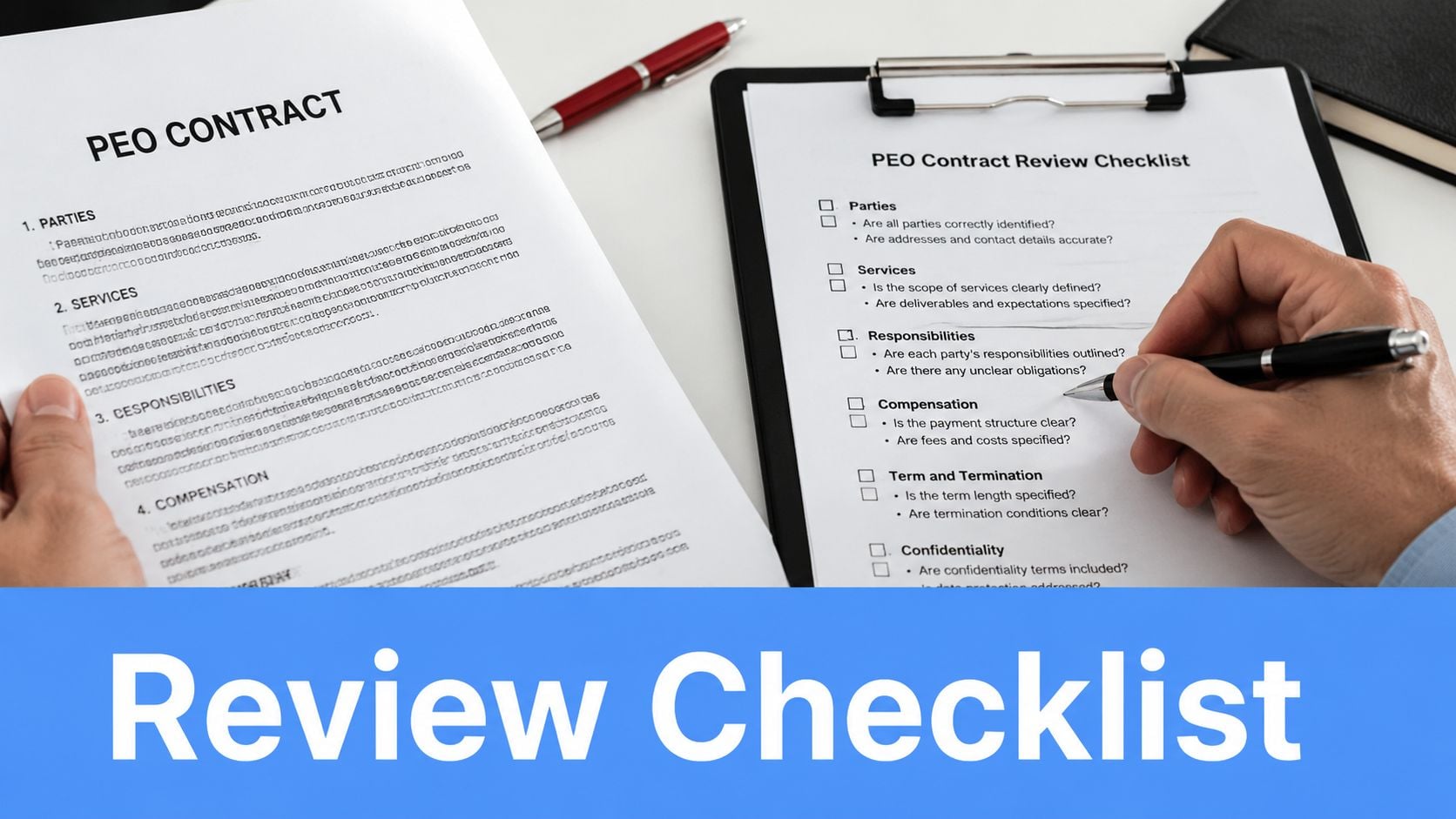
A PEO contract converts the sales proposal into operating obligations. Review it against specific failure scenarios: incorrect payroll, late tax filings, benefit disruptions, employee claims, and the need to transfer the workforce to another provider.
Start with the clauses that determine financial exposure and control. Prioritize indemnification, fee increases, benefits guarantees, workers' compensation coverage, compliance duties, data security, service levels, renewal terms, and exit rights. Legal should confirm the wording, while finance should model the cost of each obligation.
One 300-employee services company found that its draft required 90 days' notice, imposed a 4% administrative fee at exit, and allowed 60 days for employee-data transfer. Negotiation changed the terms to 30-day notice, no exit fee, and 10-day data transfer. Those provisions matter if service quality declines or the company needs to change providers.
Test the contract against failure scenarios
Responsibility must follow control. If the PEO manages payroll-tax filings, the agreement should state who pays penalties and interest when the filing is late or incorrect. A multi-state employer in the provided scenario revised its agreement so the PEO carried responsibility for payroll tax compliance.
Use this review list as a negotiation agenda:
- Termination: Confirm notice periods, early-termination penalties, transition assistance, and post-termination duties.
- Price control: Require defined escalation triggers and an annual cap. Avoid vague “market rate” language.
- Insurance protection: State the PEO's workers' compensation coverage obligations and indemnification duties if coverage is not obtained.
- Data portability: Specify ownership, export format, delivery timing, transfer cost, and access after termination.
- Liability allocation: Assign responsibility for penalties, interest, claims, and failures caused by the PEO or its vendors.
Request the contract template before selecting a preferred provider. Early review gives counsel time to negotiate protections while the company still has alternatives. Record every agreed change in the final schedule or order form, not only in email or presentation materials.
4. Multi-State Compliance Responsibility Matrix
A PEO doesn't eliminate employer responsibility. It divides responsibilities, and the division can change by state, service, and contract language. A state-by-state matrix turns that division into an operational record that HR, payroll, legal, and the PEO can maintain together.
The matrix should assign an accountable party for state unemployment insurance, income-tax withholding, wage and hour calculations, prevailing wage requirements, paid leave programs, workers' compensation filings, time records, independent contractor classification, and employee-document audits. It should also identify whether the PEO performs the work, supplies the system, reviews the result, or merely offers optional support.
A 300-employee company operating in California, Texas, and New York discovered that its PEO left wage and hour calculation responsibility with the company. The negotiation shifted that work to the PEO because the provider already operated the relevant system infrastructure. A separate staffing company found that paid family leave administration was excluded, even though the company had mandatory program obligations in California and New York. The parties added the service as an extra.
Treat responsibility as a living control
The matrix should include an update mechanism for legislative changes. A quarterly review can force the parties to discuss new state requirements instead of assuming that a general “compliance support” promise covers them.
Dependent audits and I-9 verification also need explicit ownership. The PEO may provide tools while the employer retains the duty to collect, verify, or correct records. Liability language should connect each assigned duty to indemnification for penalties, interest, and costs caused by failure to perform it.
Compliance ownership should be written at the task level. “The PEO handles compliance” is too broad to manage or defend.
The PEO HR shared responsibility matrix gives HR teams a practical structure for documenting these boundaries. The matrix should sit with the operating procedures, not disappear into contract files.
5. Workers' Compensation Claims and Experience Modifier Analysis Report
A manufacturing company learned that its 1.8 experience modifier added $180 per employee annually to workers' compensation premiums. A PEO with specialized claims management projected a 1.2 average modifier, saving $130 per employee and offsetting its higher base fee. The decision depended on claims performance, not the administrative fee alone.
Start with the employer's official experience modifier from its workers' compensation carrier. Payroll-system estimates can omit the details that drive the rating. Compare claims frequency, severity, open reserves, classification codes, carrier structure, and projected treatment under each PEO.
The report should connect these findings to the cost model. Claims management may justify a higher base fee when it reduces premiums, improves reserve discipline, or limits future claim costs. The analysis should also identify assumptions that require confirmation from the carrier, broker, or PEO.
Protect a strong modifier
A staffing company with a 0.7 modifier, below an industry average of 1.0, faced a different exposure. Moving into a PEO group experience modifier would have eliminated $50,000 annually in lost credit. The company negotiated a carve-out requiring the PEO to maintain its individual modifier.
Ask each candidate:
- Which rating applies: Does the PEO use an individual modifier, a group modifier, or a negotiated structure?
- Who handles claims: Identify adjusters, reporting channels, reserve reviews, and escalation contacts.
- What happens to open claims: Define treatment during implementation, renewal, and exit.
- How classifications are checked: Confirm that job codes and work locations match actual duties.
Fast reporting can keep minor injuries from becoming larger claims, but the proposed process needs verification. Request client references, reporting protocols, reserve-review procedures, and examples of escalation. Finance and risk teams can use this experience rating versus community rating analysis to frame the rating comparison.
Settlement assumptions also deserve a documented review. A workers' compensation settlement calculator can support internal scenario analysis, but it does not replace carrier or legal advice.

6. HR Outsourcing Service Level Agreement Template
A service promise isn't an SLA unless someone can measure it and the client has a remedy. The agreement should define response times, payroll deadlines, error correction, escalation paths, system availability, reporting, and service credits for failures that affect employees or compliance.
A 200-employee company negotiated payroll completion by 5 p.m. on the Wednesday before payday, with a 5% service credit for late payroll. The point wasn't the credit alone. The deadline created a visible control that allowed HR and finance to validate payroll before employees were affected.
Benefits support needs the same precision. An HR director negotiated 48-hour response times for benefits eligibility questions and 72-hour resolution for enrollment errors, with escalation to the PEO's vice president of customer success after 5 days. The company's average response time fell from 7 days to 2 days in the described scenario.
Define resolution, not just response
A response can mean an acknowledgment, an explanation, or a completed fix. The SLA should define which event satisfies the standard for each request category. Payroll corrections, tax issues, benefits enrollment errors, and routine HR questions may require different clocks and escalation rules.
The PEO should provide written monthly reporting against the agreed metrics. Quarterly business reviews then become decision meetings rather than informal check-ins. The parties can examine recurring failures, root causes, open escalations, and corrective actions.
Before accepting targets, request 12 months of performance data from the PEO's current clients. Targets that look impressive but aren't consistently achievable can produce disputes instead of accountability.
The strongest SLA focuses on business-critical failures, including payroll accuracy, compliance deadlines, benefits eligibility, and data access. Minor administrative requests can use a lighter service tier so the contract stays enforceable rather than overloaded with metrics no one reviews.
7. PEO Implementation and Transition Plan Template
Implementation is a payroll cutover project with financial and employee-relations risk. The transition plan should assign an owner to each dependency, define acceptance criteria, and reserve time for testing before the first live payroll.
A 250-employee company discovered during cutover preparation that benefit elections had not migrated correctly. Employees spent 2 weeks submitting inquiries and correcting coverage records, while the error also delayed a required compliance filing. A parallel payroll test and a benefits-election reconciliation would have exposed the failure before production.
Build the timeline backward
Start with the first required payroll, then work backward through system setup, data conversion, benefits enrollment, employee communications, testing, and approval. A data audit 2 to 3 months before cutover gives HR time to reconcile names, addresses, tax elections, compensation, deductions, employer contributions, employment status, and work locations.
Benefits enrollment should begin 6 to 8 weeks before cutover. Employees need time to compare plans, submit elections, and correct errors. Run a shadow payroll for at least one pay cycle, comparing gross pay, taxes, deductions, employer contributions, and net pay between the old and new systems. Reconcile benefit elections separately, because a payroll match can still conceal missing coverage data.
The plan should specify:
- Freeze date: Stop major system changes and new hires 2 weeks before cutover, where business conditions allow.
- Single owner: Assign the HR director or CFO as the primary accountability partner.
- Milestone remedies: Tie missed enrollment or first-payroll milestones to credits or other remedies.
- Validation signoff: Require HR and finance approval before releasing the first live payroll.
- Issue log: Record each defect, owner, deadline, employee impact, and resolution before signoff.
An HR director in the provided scenario negotiated a 30-day money-back guarantee if the PEO missed critical implementation milestones. That term gives the provider a financial reason to meet the agreed transition plan, while internal signoff keeps responsibility for approval with the company.
8. PEO Exit and Transition Playbook
A PEO exit is a financial decision and an operational separation. Waiting until dissatisfaction becomes urgent can leave the provider controlling payroll records, benefits information, tax history, claims details, and employee data while the replacement system remains untested.
Set the exit threshold before giving notice. Compare termination fees, transition work, overlapping providers, internal effort, and expected savings. A 175-employee company estimated $35,000 in transition costs and fees against $60,000 in annual savings, producing a 7-month payback. That calculation gave leadership a defensible basis for leaving.
The same discipline applies to data access. One HR director found that the PEO planned to charge $5,000 for employee-record exports and required 60 days to transfer them. Early negotiation reduced the fee to $0 and the transfer period to 10 days. Preserve records of service failures or contractual breaches, because documented evidence can support negotiations over exit fees and transition assistance.
Make the exit a controlled project
Begin at least 6 months before the target date. Replacement payroll implementation may require 60 to 90 days, and the budget should include exit fees, system setup, 100 to 200 hours of internal effort, provider overlap, benefits continuation, and reconciliation work.
Use a decision file that assigns an owner to each control:
- Contract terms: Confirm notice, renewal, termination, data-return, and post-termination obligations.
- Record custody: Export payroll, tax, benefits, personnel, and claims data, then test file completeness before access ends.
- Benefits handoff: Set up COBRA administration, address coverage gaps, validate elections, and prepare employee communications.
- Payroll cutover: Process and validate a PEO payroll before releasing the first payroll through the replacement system.
- Final reconciliation: Match wages, taxes, invoices, credits, deposits, and open claims, then document unresolved liabilities.
The PEO exit strategy offers a practical framework for managing termination as a planned project rather than a last-minute vendor dispute.
8-Point PEO Resource Comparison
| Tool | Primary purpose | Target audience | Top value / USP | Main limitations |
|---|---|---|---|---|
| PEO Cost Comparison Spreadsheet Template | Model total cost of ownership across multiple PEOs | CFOs, Finance leaders | Reveals all‑in costs, scenario modeling, negotiation leverage | Requires accurate internal data; customization for varied PEO structures |
| PEO Selection Scorecard & Evaluation Framework | Weighted scoring of vendors across key dimensions | HR, Finance, Leadership teams | Quantifies trade‑offs, customizable weights, defensible recommendation | Quality depends on due diligence; weighting can be subjective |
| PEO Contract Review Checklist | Identify and flag risky contract clauses before signing | Legal, Finance, Procurement | Highlights red flags, suggests market‑standard language, prioritizes negotiation | Some items need legal expertise; not industry‑specific |
| Multi‑State Compliance Responsibility Matrix | Clarify state‑by‑state compliance ownership | Multi‑state employers, Compliance teams | Prevents compliance gaps, forces explicit PEO commitments | Requires deep state law knowledge; needs frequent updates |
| Workers' Compensation Claims & Experience Mod Analysis Report | Analyze mod, claims drivers, and projected comp costs | Risk managers, CFOs, Benefits leads | Quantifies comp cost impact, benchmarks carriers, aids negotiations | Needs 3 years of claims data; projections are estimates |
| HR Outsourcing Service Level Agreement (SLA) Template | Define measurable service standards and remedies | HR leaders, Procurement | Ties performance to penalties, creates enforceable expectations | PEOs may resist strict SLAs; credits may not cover real losses |
| PEO Implementation & Transition Plan Template | Manage onboarding timeline, tasks, and responsibilities | HR, Project managers, Finance | RACI, cutover plan, success metrics reduce implementation risk | Requires 200–400 hours internal effort; data issues can delay cutover |
| PEO Exit & Transition Playbook | Step‑by‑step guide to leaving a PEO safely | HR, CFOs, Operations | Roadmap for exit costs, data export, parallel payroll to avoid failures | Exit can be costly; contracts may include prohibitive penalties |
Turn the Resource List Into a Decision File
The eight professional employer resources become valuable when they produce one connected decision file. The file should show not only which PEO won, but why the provider won, which assumptions drove the result, who owns each risk, and what conditions would justify renegotiation or exit.
The first document should be the cost model. Finance should preserve employee counts, payroll assumptions, benefits costs, workers' compensation treatment, implementation effort, renewal assumptions, and exit costs. The model should separate known fees from estimates and show how the result changes under different headcount outcomes. That prevents a low introductory quote from becoming the permanent reference point.
Next, leadership should score finalists using agreed weights. HR, finance, operations, and legal won't value every dimension equally, so the weighting discussion should happen before vendor scores influence the group. The final scorecard should include written evidence from demonstrations, references, contract responses, and compliance discussions.
Assign owners before signature
The compliance matrix should identify the party responsible for every recurring state and federal task. The contract should then reflect that allocation through clear duties, indemnification, data rights, insurance commitments, fee controls, renewal protections, and exit assistance. A responsibility matrix that conflicts with the agreement will create confusion when a deadline is missed.
The SLA should convert service expectations into measurable standards. Payroll deadlines, error correction, benefits response times, escalation paths, reporting, and quarterly reviews need named owners. A service credit won't restore employee trust after a payroll failure, but a clear SLA gives the client evidence, influence, and a structured correction process.
Implementation and exit plans should be stored with the same decision record. The implementation plan protects the first payroll and benefits enrollment. The exit playbook protects continuity if the provider fails, the company outgrows the model, or the economics change. French portage salarial rules illustrate why local legal review matters in international arrangements: providers must maintain a financial guarantee equal to 10% of the prior year's wage bill, with a floor of €96,120, and ending the commercial contract doesn't automatically end the employee's employment contract. Details like these shouldn't be generalized across jurisdictions.
The broader market also supports disciplined buyer behavior. In the United States, the PEO industry grew from 487 PEOs at the end of 2020 to 523 at the end of 2022, while worksite employees rose from 3.97 million to 4.5 million and total wages increased from $216 billion to $308 billion. NAPEO reported that those 4.5 million employees supported more than 208,000 primarily small and midsize businesses, and represented 17% of U.S. employers with 10 to 99 employees. These figures are reported in the professional employer organization market overview. Growth makes comparison more important, not less, because a larger vendor market doesn't guarantee a better fit.
A separate forecast estimated the global PEO market at $73.58 billion in 2025, projecting $189.75 billion by 2034 at an 11.1% CAGR. A U.S.-focused estimate placed the American market at $58.46 billion in 2025, with a projection of $120.40 billion by 2034, as reported in the U.S. professional employer organization market forecast. Those are projections, not guarantees, but they reinforce the scale of the category.
Adoption remains limited relative to eligible employers. Industry estimates put PEO usage at less than 5% of private-sector employers, despite adoption rising about 40% since 2008. The same estimate places coverage at roughly 3.05 million to 4.0 million worksite employees and about 173,000 small and midsize businesses, according to this PEO market adoption analysis. For buyers, that means there may be room to improve an existing arrangement, but it also means sales momentum shouldn't substitute for independent evaluation.
Federal filing responsibilities require the same care. IRS Form 941 instructions require aggregate return filers to identify whether they file as a section 3504 agent, CPEO, or another third party, and CPEOs generally file Form 941 and Schedule R electronically, as described in the IRS Form 941 instructions. For ACA reporting, the common-law employer generally remains responsible for determining applicable large employer status and for furnishing and filing Forms 1094-C and 1095-C, even when a PEO helps prepare or submit them, according to this ACA reporting responsibility explanation.
A defensible PEO decision therefore has six visible actions: model total cost, score finalists, map compliance ownership, review contract risk, negotiate service standards, and document implementation or exit milestones. PEO Metrics can serve as one independent resource for side-by-side PEO analysis, benchmarking, and negotiation support, provided the buyer preserves its own assumptions and makes the final decision against its actual operating needs.
PEO Metrics helps HR, finance, and leadership teams compare PEO providers using pricing, benefits, contract terms, service quality, compliance support, and industry fit. Visit PEO Metrics to benchmark the current arrangement, compare alternatives, and identify negotiation points before renewal, selection, implementation, or exit.
