
Commercial construction payroll involves complex, multi-jurisdictional compliance challenges that standard payroll software can’t handle—from prevailing wage requirements and certified reporting to union pay structures across multiple job sites. Commercial Construction PEO Payroll Services designed specifically for contractors automate these layered obligations, managing tax jurisdictions, fringe benefit tracking, and simultaneous pay structures so you’re not manually cross-referencing wage d…
When your lawn care business reaches 100 employees, you’ve entered a critical growth phase where HR complexity demands professional support but you’re not large enough for a full internal department. This guide provides seven targeted strategies for selecting a lawn care PEO that understands your industry’s unique challenges—seasonal workforce fluctuations, elevated workers’ comp risks, equipment liability, and managing dispersed crews—helping you navigate this pivotal transition with the rig…
Tree service companies face sky-high workers’ comp costs due to the inherent dangers of working at heights with heavy equipment and chainsaws. A specialized PEO for tree service companies can dramatically reduce these insurance premiums and provide safety programs tailored to arboriculture’s unique risks, but finding providers who understand the industry’s seasonal workforce needs and won’t overprice high-risk classifications requires careful evaluation.
Finding the best PEO for tree service companies requires providers who understand high-risk arborist classifications, seasonal crew management, and the unique workers’ comp challenges of chainsaw and climbing work. This guide evaluates seven PEO options specifically suited for tree care operations, from small trimming crews to multi-territory climbing teams, focusing on transparent pricing, safety protocol expertise, and flexibility for the operational realities arborists face daily.
When your plumbing company reaches 100 employees, you gain real negotiating power with PEO providers but need specific strategies to leverage it effectively. This guide outlines seven critical approaches for selecting a plumbing PEO for 100 employees that address your unique challenges—from managing workers’ comp costs across multi-state crews to handling complex payroll and compliance needs without a full internal HR department.
Electrical contractors face unique HR challenges including high workers’ comp exposure, complex licensing requirements, and prevailing wage compliance across multiple job sites. This guide outlines seven targeted strategies for selecting and working with a PEO for electrical contractors, focusing on tactical decisions that address construction-specific pain points like EMR management, multi-state licensing, and jobsite workforce coordination—helping you avoid turning your PEO relationship int…
Finding the best PEO for electrical contractors requires understanding industry-specific challenges like multi-site workers’ comp classification, certified payroll for federal projects, and experience modification rates that impact bid competitiveness. Unlike generic PEOs designed for office environments, electrical contractors need partners who can handle complex scenarios where the same employee works across different job types, each requiring distinct safety protocols, wage rates, and comp…
A Professional Employer Organization (PEO) can help electrical contractors manage workers’ comp costs, multi-state payroll, and talent recruitment, but they also introduce pricing complexity, reduced control, and potential friction with prevailing wage projects. This guide examines the real electrical contractors PEO pros and cons based on industry-specific challenges like high workers’ comp exposure, multi-jobsite operations, and apprenticeship requirements to help you determine if a PEO mak…
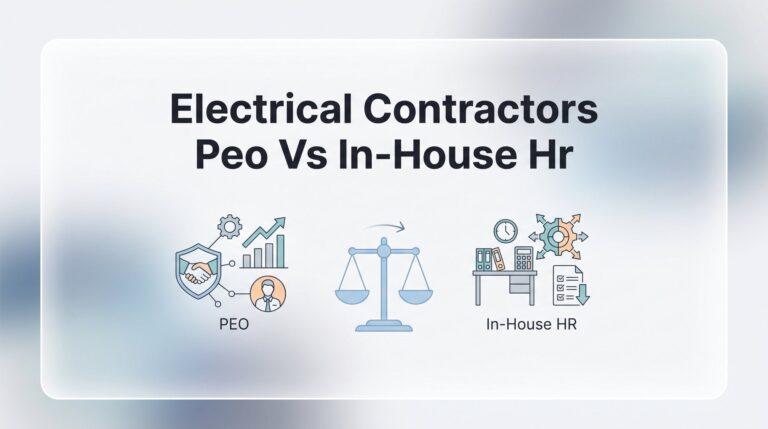
Electrical contractors face unique HR challenges with multi-state crews, apprentice training requirements, and high-risk work environments that make the PEO versus in-house HR decision more complex than other industries. This guide examines seven specific decision factors—including headcount, growth plans, administrative capacity, and risk management—to help electrical contractors determine which HR approach fits their operational reality and business goals.
Electrical contractors face unique HR challenges including high-risk workers’ comp, multi-site payroll, apprenticeship compliance, and complex licensing requirements that generic PEOs can’t handle. This guide reviews the top electrical contractors PEO providers for 2026, evaluating each on construction-specific capabilities like workers’ comp expertise, prevailing wage calculations, safety programs, and trade contractor value—whether you’re managing a small residential crew or large commercia…
Electrical contractors with 5 employees face unique HR challenges managing payroll, workers’ comp, and benefits without dedicated staff. This guide provides seven practical strategies to evaluate whether a PEO (Professional Employer Organization) makes financial sense for your electrical contracting business, focusing on workers’ comp calculations, insurance considerations specific to the trade, and honest cost-benefit analysis to determine if outsourcing HR is right for your crew size.
Electrical contractors with 25 employees face unique HR challenges including OSHA compliance, prevailing wage tracking, and workers’ comp for high-risk incidents that generic solutions can’t address. An Electrical Contractors PEO for 25 Employees must handle job costing integration, multi-state licensing, and complex workforce classifications while offering competitive benefits to retain skilled journeymen without requiring a full-time HR manager.