
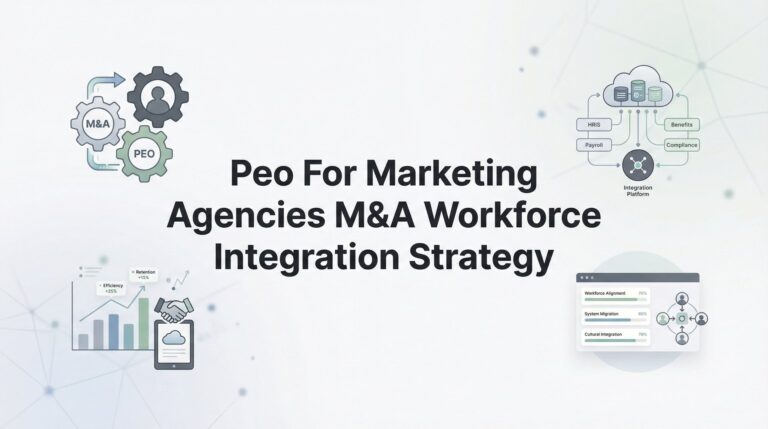
Marketing agency acquisitions fail when workforce integration is mishandled, particularly when dealing with multiple payroll systems and benefits packages that can drive away the creative talent you just acquired. A Professional Employer Organization (PEO) provides the HR infrastructure backbone for M&A workforce integration strategy, consolidating administrative systems while preserving the people who actually deliver client value—making it essential for marketing agencies where talent reten…
When you bring on a PEO while maintaining internal risk management, unclear boundaries create dangerous gaps where compliance issues fall through or costly redundancies where you pay twice for the same coverage. Successful PEO and internal risk management alignment requires clearly defined responsibilities, documented handoff points, and treating the relationship as a strategic partnership rather than a simple outsourcing arrangement.
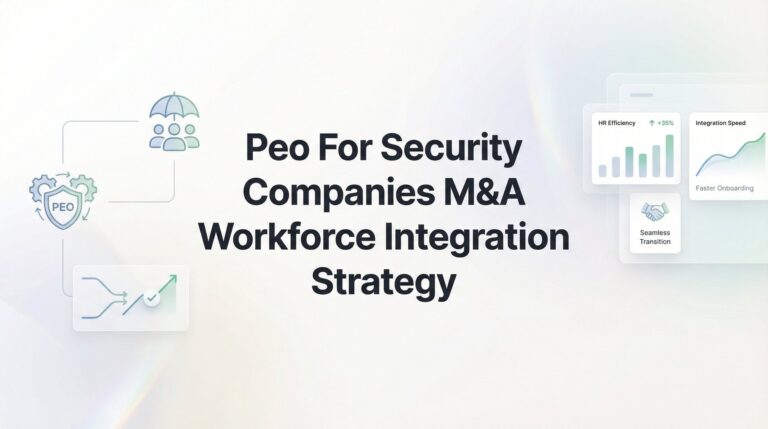
Merging security companies requires specialized PEO solutions that can handle the unique complexities of M&A workforce integration, including multi-state guard certifications, security clearances, and high-risk workers’ comp policies. This guide evaluates the top PEO for security companies M&A workforce integration strategy providers based on their ability to consolidate payroll systems, harmonize benefits, maintain compliance across jurisdictions, and ensure uninterrupted 24/7 security opera…
Enterprises with existing HR teams can strategically split functions by keeping high-value activities like recruiting and culture in-house while outsourcing compliance-heavy tasks to a PEO. This guide explains how to structure a PEO enterprise hybrid configuration that avoids ownership gaps, ensures system integration, and maximizes value without surrendering control of your entire HR operation.
A PEO policy approval governance model defines who has decision-making authority over HR policies in a co-employment relationship—preventing situations where benefits or PTO rules change without your knowledge. This framework clarifies which policies require your approval, which the PEO controls for compliance, and which need joint sign-off, eliminating the costly ambiguity that creates friction when one party makes unexpected decisions the other didn’t authorize.
Janitorial companies face unique workers compensation challenges including volatile experience mods, carrier non-renewals, and complex Class Code 9014 classifications that generic PEOs can’t properly address. This guide reviews seven specialized PEOs for janitorial services with advanced workers comp structuring capabilities, focusing on experience mod management, pay-as-you-go options, proactive loss control programs, and stable carrier relationships that remain committed through claims—help…
Acquiring a company that uses a PEO creates unique M&A challenges because co-employment relationships and bundled services don’t transfer cleanly like traditional HR systems. This guide provides specific steps for PEO HR infrastructure evaluation in M&A, helping acquirers identify hidden liabilities, assess contractual obligations, and plan seamless post-close integration while avoiding costly compliance gaps and unexpected delays.
A PEO workforce consolidation strategy addresses the operational complexity that emerges when companies manage multiple HR systems across different entities, acquisitions, or geographic expansions. This approach focuses on unifying fragmented payroll, benefits, and compliance infrastructure under a single PEO provider to eliminate manual reconciliation, reduce administrative overhead, and create scalable HR architecture that supports both current operations and future growth without disruptin…
Successfully integrating your PEO with existing HR systems requires careful planning to avoid costly data migration errors, manual workarounds, and workflow disruptions. This peo hr technology integration checklist provides 8 practical steps to ensure your payroll, time tracking, and benefits platforms connect seamlessly with your new PEO, protecting employee trust while delivering the efficiency gains you invested in.

Private equity firms acquiring multiple portfolio companies face fragmented HR systems across payroll providers, benefits packages, and compliance documentation. A strategically implemented PEO for private equity portfolio companies can accelerate integration timelines, improve EBITDA margins, and strengthen exit positioning by consolidating HR operations—but the wrong choice creates costly switching barriers that reduce enterprise value during the typical 3-7 year hold period.
When acquiring or selling a company that uses a Professional Employer Organization (PEO), conducting a thorough PEO workforce compliance audit in M&A is essential to uncover hidden liabilities that exist in the gap between what the company manages and what the PEO handles. This step-by-step guide shows you exactly where to look and what questions to ask during due diligence to identify compliance risks in co-employment relationships before they become costly post-acquisition problems.
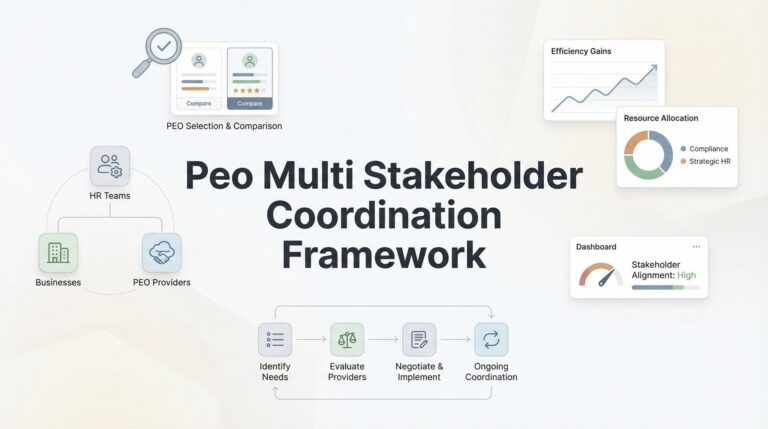
Managing a PEO relationship requires coordinating multiple departments—finance, HR, operations, and leadership—each with different priorities and concerns. This guide provides seven actionable strategies for implementing a peo multi stakeholder coordination framework that prevents duplicated efforts, eliminates communication breakdowns, and ensures your PEO engagement delivers maximum value through clear accountability and practical processes that work for busy teams.