
The PEO agreement is signed, the kickoff call is on the calendar, and then an HR director gets the email that changes…
Car wash owners using a PEO gain access to large-group employee benefits—health insurance, retirement plans, and more—that would otherwise be out of reach for small operations, helping address the staffing turnover that costs the business far more than the benefits themselves.
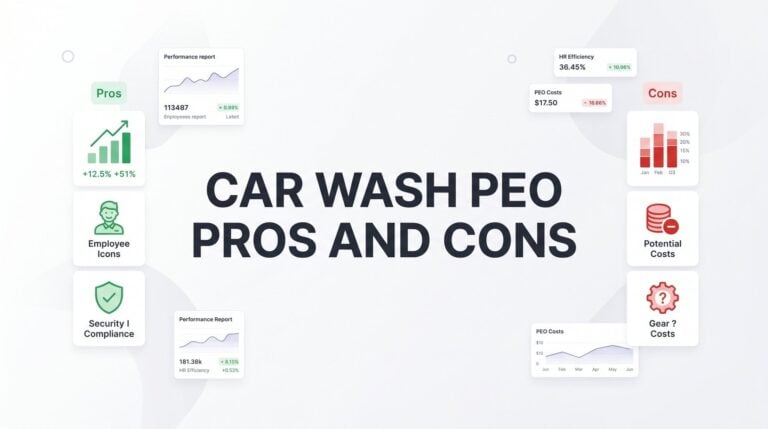
Car wash operators face unique HR challenges — high turnover, slip-and-fall liability, and complex workers’ comp classifications — that make understanding car wash PEO pros and cons essential before committing to a contract. This guide breaks down where a PEO genuinely helps, where it may cost more than it saves, and the operational variables that determine whether the arrangement makes sense for your specific business.
Car wash operators face a genuine choice between PEOs and payroll companies, and the wrong decision can quietly drive up workers’ comp costs, compliance risk, and turnover in an industry defined by physical hazards and high employee churn. This guide breaks down the real functional differences between the two options specifically for car wash businesses, so operators can match the right solution to their actual risk profile and staffing challenges.
Small trucking companies with around 15 employees face unique HR and compliance challenges that generic PEOs aren’t equipped to handle. This guide explains how to evaluate and select a trucking PEO for 15 employees that understands DOT requirements, workers’ comp risk, and fleet-specific liability rather than treating your operation like any other small business.
Switching logistics companies to a PEO involves real operational risk — payroll continuity, benefits coverage, and workers’ comp must stay intact throughout the transition. This step-by-step guide covers the practical mechanics of moving your drivers, warehouse crews, and multi-state workforce into a PEO without disruption.
A project can look fine in the estimate, survive the billing cycle, and still disappoint in the post-job review. Leadership usually blames…
Towing companies face unique PEO challenges — from high-hazard workers’ comp classifications to DOT compliance and variable-schedule workforces — and most generalist providers aren’t equipped to handle them. This guide identifies the best PEO for towing companies by focusing on providers that can genuinely manage heavy-recovery risk profiles, driver compliance complexity, and flexible benefits structures, starting with a comparison tool to help operators evaluate options before signing.
Towing PEO pricing operates differently than most industries due to high-risk classifications, roadway exposure, and claims profiles that directly shape every proposal. This guide breaks down the specific cost drivers—from driver mix to fleet exposure—that determine what towing operators actually pay for PEO services and how to evaluate whether a proposal reflects fair pricing for the risk involved.
Towing companies face steep workers comp premiums and limited carrier options due to the high-risk nature of roadside work, making a Towing PEO Workers Compensation Program a practical alternative that pools employees under a PEO’s master policy to improve coverage access and stabilize costs for small operators who can’t negotiate favorable standalone terms.
Switching auto repair shops to a PEO requires careful planning around flat-rate technician pay, workers’ comp classifications, and payroll continuity to avoid costly errors. This guide walks through the real transition sequence — from vetting agreements to configuring pay structures correctly — so your team stays paid accurately and your shop keeps running without disruption.
Switching auto dealerships to a PEO can consolidate complex HR functions—covering commissioned salespeople, flat-rate technicians, and multi-rooftop compliance—while reducing costs, but the transition requires careful planning around dealership-specific payroll structures, workers’ comp classifications, and state licensing requirements. This step-by-step guide walks dealers through exactly how to make the switch without disrupting operations.