
Water damage restoration companies face uniquely complex payroll challenges—from unpredictable crew scaling during storm surges to multi-state compliance and high-risk workers’ comp classifications. Water Damage Restoration PEO Payroll Services offer restoration business owners a specialized solution that handles employment tax filings, workers’ compensation coverage, and regulatory compliance, allowing operators to focus on emergency response rather than administrative exposure.
Water damage restoration PEO compliance support addresses the unique regulatory challenges restoration business owners face—spanning multi-state labor law, workers’ comp classification, and environmental health requirements that standard PEOs often aren’t equipped to handle. This guide breaks down what compliance actually looks like in a high-volatility, round-the-clock industry and how to evaluate whether a PEO partnership genuinely fits your operational reality.
Understanding the water damage restoration PEO pros and cons is essential before signing a contract, as these co-employment arrangements can streamline HR, reduce workers’ comp costs, and improve technician retention — but structural mismatches and rigid contract terms may create more operational friction than they eliminate for some restoration contractors.
Understanding Water Damage Restoration PEO Contract Terms is critical before signing, as most standard PEO agreements are built for stable businesses—not restoration companies managing surge staffing, multi-state deployments, and hazardous exposure classifications. This guide breaks down the specific contract language that creates costly problems for restoration contractors and what to scrutinize before committing.
Understanding your water damage restoration PEO cancellation policy before signing can prevent costly surprises when you need to exit the relationship. This guide breaks down common contract traps—including notice periods, early termination penalties, and workers’ comp coverage gaps—helping restoration business owners negotiate better terms and avoid being locked into a PEO arrangement that no longer serves their operational or financial needs.
Fire Protection PEO Pricing & Cost Structure varies significantly across providers due to the industry’s unique risk profile, licensing complexity, and workers’ comp exposure — factors most generic PEO guides ignore. This breakdown explains exactly what drives each cost component for fire protection contractors, what’s negotiable, and how to compare quotes that seem impossible to evaluate side by side.
Fire protection contractors face unique challenges securing affordable workers compensation coverage due to elevated trade risks that many standard PEOs avoid entirely. This guide explains how a Fire Protection PEO Workers Compensation Program works, what separates programs that genuinely reduce costs from those that don’t, and the critical factors contractors should evaluate before signing any agreement.
Fire Protection PEO Payroll Services offer specialized workforce management solutions designed for the unique compliance demands of fire protection contractors—including multi-state licensing, certified payroll, workers’ comp classifications, and mixed union/non-union crews. Before signing with a PEO, contractors need to understand what these services actually cover, where generic providers fall short, and how to evaluate a partner built for the life safety industry’s specific operational com…
Fire protection PEO compliance support can ease specific administrative burdens like workers’ comp classifications and payroll taxes, but it doesn’t cover the full compliance stack fire protection businesses face. This guide breaks down exactly what a PEO handles versus what remains the business owner’s responsibility—including licensing, EPA reporting, and NFPA requirements—helping contractors make an informed decision about whether a PEO partnership makes sense for their operation.
Fire protection employee benefits through a PEO give small and mid-sized fire protection companies access to competitive health insurance, workers’ comp rates, and HR administration typically reserved for larger employers. This guide helps owners understand how PEO co-employment works, what cost advantages are realistic for companies with five to forty employees, and how to evaluate whether the arrangement makes sense for retaining licensed tradespeople in a competitive labor market.
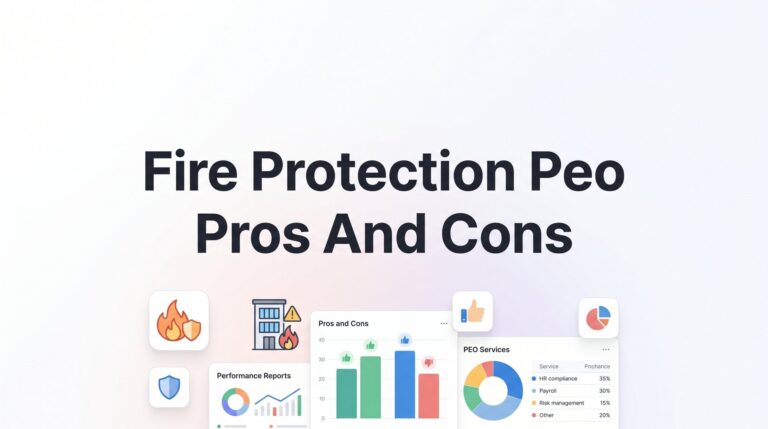
Fire protection business owners evaluating Fire Protection PEO pros and cons will find an honest breakdown of when outsourcing HR, payroll, and workers’ comp through a Professional Employer Organization makes sense—and when the industry’s unique risk profile, mixed workforce structures, and multi-state licensing complexity make a PEO contract more liability than relief.
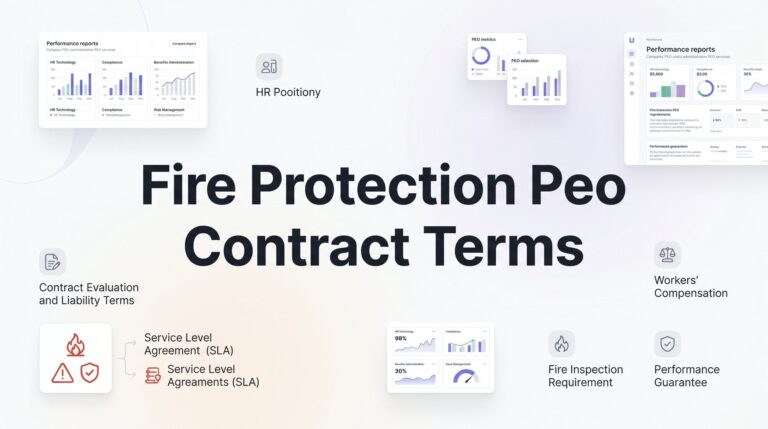
Understanding fire protection PEO contract terms before signing can prevent costly surprises like misclassified worker comp rates, hidden cancellation fees, and mid-year exit penalties. This guide walks fire protection business owners through the critical contract clauses that directly impact their risk exposure, pricing accuracy, and flexibility when managing crews across high-stakes classifications like sprinkler installation and inspection.