
Backflow testing companies considering a PEO should carefully review cancellation terms before signing, as exit fees, auto-renewal clauses, and rigid contract structures can create costly surprises when seasonal staffing levels shift. Understanding your backflow testing PEO cancellation policy upfront helps owners avoid being locked into agreements that no longer fit their business after municipal contracts end or crew sizes change.
A Backflow Testing PEO for 5 Employees fills the critical gap between solo operator simplicity and enterprise HR complexity, offering seven practical strategies to manage workers’ comp exposure, payroll compliance, and liability risks specific to backflow testing operations—without the cost of a dedicated HR hire.
Small backflow testing companies with around 15 employees face unique HR challenges that a generic PEO often isn’t equipped to handle. A Backflow Testing PEO for 15 Employees can bridge the compliance, workers’ comp, and benefits gap — but only if you choose a provider that understands specialty trade contractor risk profiles and licensing requirements specific to your industry.
Backflow testing companies with 25 employees face unique HR challenges—too large to manage compliance informally, too small for a dedicated HR team—making the right Backflow Testing PEO for 25 Employees a critical decision. This guide outlines seven practical strategies for evaluating and maximizing a PEO partnership that accounts for licensed trade requirements, field worker classifications, and the specific compliance demands of the backflow testing industry.
Backflow testing companies with around 50 employees face unique HR and compliance challenges that generic PEO solutions often fail to address. This guide outlines seven practical strategies for evaluating a Backflow Testing PEO for 50 Employees, helping field-heavy operations navigate workers’ comp exposure, state licensing requirements, and complex payroll to find a provider that delivers real cost savings rather than hidden expenses.
Managing a Backflow Testing PEO for 100 Employees requires a strategic approach, as this headcount sits in a unique zone where informal HR falls short but a full in-house department isn’t yet justified. This guide outlines seven practical strategies to help backflow testing business owners select and manage a PEO that understands licensed trade complexities, proper workers’ comp classifications, and the split demands of field technicians and office staff.
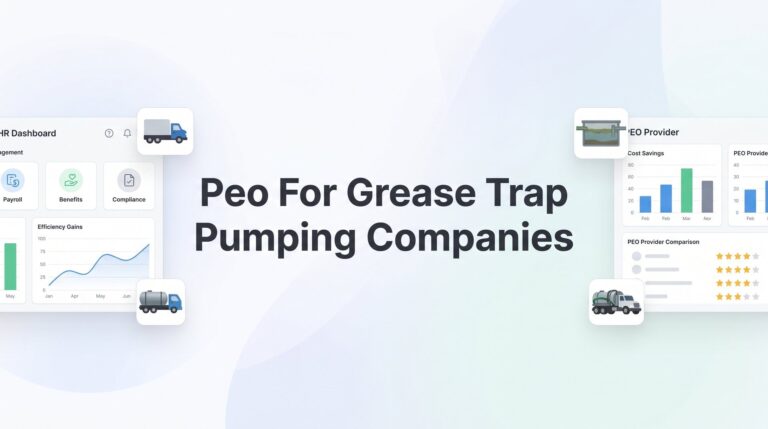
Small grease trap pumping companies face unique HR and compliance challenges—managing CDL drivers, hazardous waste crews, and DOT oversight with limited headcount. This guide identifies the best PEO for grease trap pumping companies based on workers’ comp expertise, risk classification accuracy, and hands-on service for environmental and liquid waste hauling operations.

Finding the best PEO for grease trap pumping companies requires identifying providers that understand hazardous waste handling, DOT compliance, and high-risk workers’ comp classifications rather than repricing or declining coverage after year one. This guide evaluates eight PEOs with proven experience in field service and environmental trades, helping operators with 10–40 employees streamline HR administration, CDL driver compliance, and rapid certificate of insurance delivery for municipal c…
Grease trap pumping business owners face unique challenges securing reliable workers compensation coverage due to the industry’s high-risk profile, including confined space entry and hydrogen sulfide exposure. A specialized Grease Trap Pumping PEO Workers Compensation Program can provide co-employment solutions that genuinely cover field crews without hidden exclusions, helping operators navigate an insurance market that routinely declines or underfunds coverage for this hazardous trade.
Grease Trap Pumping PEO Payroll Services offer a practical solution for operators managing variable schedules, per-job pay structures, mixed labor classifications, and complex compliance requirements that generic payroll software struggles to handle. A Professional Employer Organization assumes co-employer status to manage payroll processing, tax administration, and HR compliance, reducing manual workarounds and administrative burden for grease trap pumping businesses.
Grease trap pumping companies face a uniquely complex compliance landscape spanning environmental regulations, OSHA confined space standards, CDL requirements, and employment law simultaneously. This guide explains how Grease Trap Pumping PEO Compliance Support helps operators manage workers’ comp, payroll, and multi-layered regulatory obligations so they can focus on keeping routes running and customers serviced.

Grease trap pumping companies struggling to retain skilled CDL drivers and pump technicians can access competitive health insurance and 401(k) benefits through a PEO, leveling the playing field with larger competitors. Grease trap pumping employee benefits through PEO arrangements allow small operators with as few as 12 employees to offer Fortune 500-level benefit packages by pooling workers under the PEO’s master plan, solving the retention problem that typically hits around years three and …