
Most advice on the leasing of employees gets one dangerous point wrong. It treats employee leasing, PEO co-employment, and even staffing as if they’re interchangeable labels for the same outsourcing decision. They aren’t. For an HR director or CFO, that confusion can turn into the wrong tax setup, the wrong benefit assumptions, and a service agreement that looks efficient until a renewal, audit, or plan test exposes the gap.
That’s a real problem in a market that isn’t small or niche. The U.S. Professional Employer Organization industry, which functions as the primary vehicle for employee leasing, reported over $12 billion in annual revenue in 2022, supports over 4.5 million employees, and has seen 15–18% year-over-year growth in client acquisition since 2020, according to Safeguard Global’s overview of international employee leasing. Volume doesn’t remove complexity. It often hides it.
A finance team can sign what looks like a routine outsourcing contract and still end up asking the wrong questions. Who is filing payroll taxes. Who is carrying workers’ compensation. Who controls plan eligibility. Which workers count for retirement plan testing. Those aren’t side issues. They drive cost, liability, and operational control.
Table of Contents
- The Hidden Risks in Using Employee Leasing and PEO Interchangeably
- Four Workforce Models Demystified
- The Critical Compliance and Liability Traps
- Matching the Right Model to Your Business Scenario
- How to Analyze the True Cost of Employee Leasing vs PEOs
- Weighing the Strategic Benefits and Hidden Risks
- Your Evaluation Checklist and Negotiation Playbook
The Hidden Risks in Using Employee Leasing and PEO Interchangeably
A buyer can use the same word and mean two completely different legal structures. That’s where mistakes start. In common conversation, vendors often blur “employee leasing” and “PEO” because both involve outsourced payroll and shared HR administration. In practice, the distinction changes who carries responsibility, how benefits are handled, and what surprises show up later.
A common example looks harmless at first. A company uses a “leasing” arrangement for a group of long-term workers, assumes they sit outside the company’s own retirement plan, and then learns those workers may need to be counted for benefit plan purposes because of the nature and duration of the relationship. That isn’t a technical footnote. It can affect eligibility, testing, and cost.
Why the wording problem turns into a financial problem
The wrong label causes leaders to compare the wrong things:
- Cost model confusion means one proposal looks cheaper because the markup is buried in labor pricing while another shows a clear administrative fee.
- Liability confusion means a client assumes the provider absorbs risk that remains shared.
- Benefits confusion means HR builds plan strategy around the payroll arrangement instead of the legal treatment of the worker.
Practical rule: If a provider can’t explain who is responsible for payroll taxes, workers’ compensation, benefit administration, and retirement plan treatment in plain contract language, the buyer shouldn’t rely on the sales summary.
The hardest part is that both models can sound polished in a demo. Key differences sit in service agreements, tax responsibility language, benefit plan documents, and state-specific rules. Many of the gray areas that matter most show up only after implementation, which is why a buyer should understand the PEO liability grey areas explained before signing anything.
The better way to approach the decision
A cleaner framework starts with four questions. Who is the employer for tax purposes. Who controls the work. Who sponsors or administers benefits. Which workers could still be treated as the client’s own employees under benefit rules.
That framework cuts through the marketing language fast. It also prevents a company from solving an administrative burden while creating a more expensive compliance problem.
Four Workforce Models Demystified
Four structures get mixed together all the time. Employee leasing, PEO co-employment, ASO services, and temporary staffing can all involve outside support, but they solve different problems. A buyer who treats them as substitutes usually ends up overbuying service, underestimating risk, or comparing prices that aren’t built on the same assumptions.
A practical way to separate the models
A simple analogy helps. Employee leasing is closer to renting labor through another company’s employment structure. A PEO is closer to hiring a co-employment platform that handles payroll, tax administration, and HR infrastructure while the client still runs the workforce day to day. An ASO provides administrative support without stepping into co-employment. Temp staffing fills short-duration labor needs where the provider is supplying workers for a temporary assignment.
A company hiring remote administrative help, for example, might first look at outsourcing before it ever needs a PEO. For some teams, especially those testing distributed support roles, resources like LatAm VAs can help clarify whether the need is role-based outsourcing or a full workforce administration model.
For teams comparing co-employment against admin-only support, this breakdown of the difference between PEO and ASO is often the more useful starting point than generic leasing definitions.
Comparison of Workforce Outsourcing Models
| Attribute | Employee Leasing | PEO (Co-Employment) | ASO (Administrative Services) | Temp Staffing |
|---|---|---|---|---|
| Employer structure | Workers are employed through the leasing entity for the arrangement | Shared employment relationship between client and PEO | Client remains the employer | Staffing firm employs workers assigned temporarily |
| Day-to-day supervision | Client usually directs the work | Client directs the work | Client directs the work | Client directs assigned tasks, staffing firm manages employment relationship |
| Payroll and tax administration | Often handled through the leasing firm | Handled through the PEO under the co-employment model | Supported administratively, but client retains employer status | Handled by the staffing provider |
| Benefits administration | Varies and is often narrower or role-specific | Often bundled into a broader HR and benefits platform | Can be supported, but benefits remain under client structure | Typically limited to temp workforce context |
| Best fit | Defined labor groups and specific employment structures | Growing companies that want broader HR, payroll, compliance, and benefits support | Companies with internal HR strength that want admin help | Seasonal, project-based, or short-term labor demand |
| Main risk | Hidden markups and unclear long-term benefit implications | Service mismatch if the provider model doesn’t fit the company | Client still holds more direct responsibility | Temp assignment drifts into long-term workforce dependence |
A buyer should read proposals with this question in mind: is the company outsourcing administration, changing the employment structure, or just filling labor temporarily? That single distinction usually clears up most confusion.
The Critical Compliance and Liability Traps
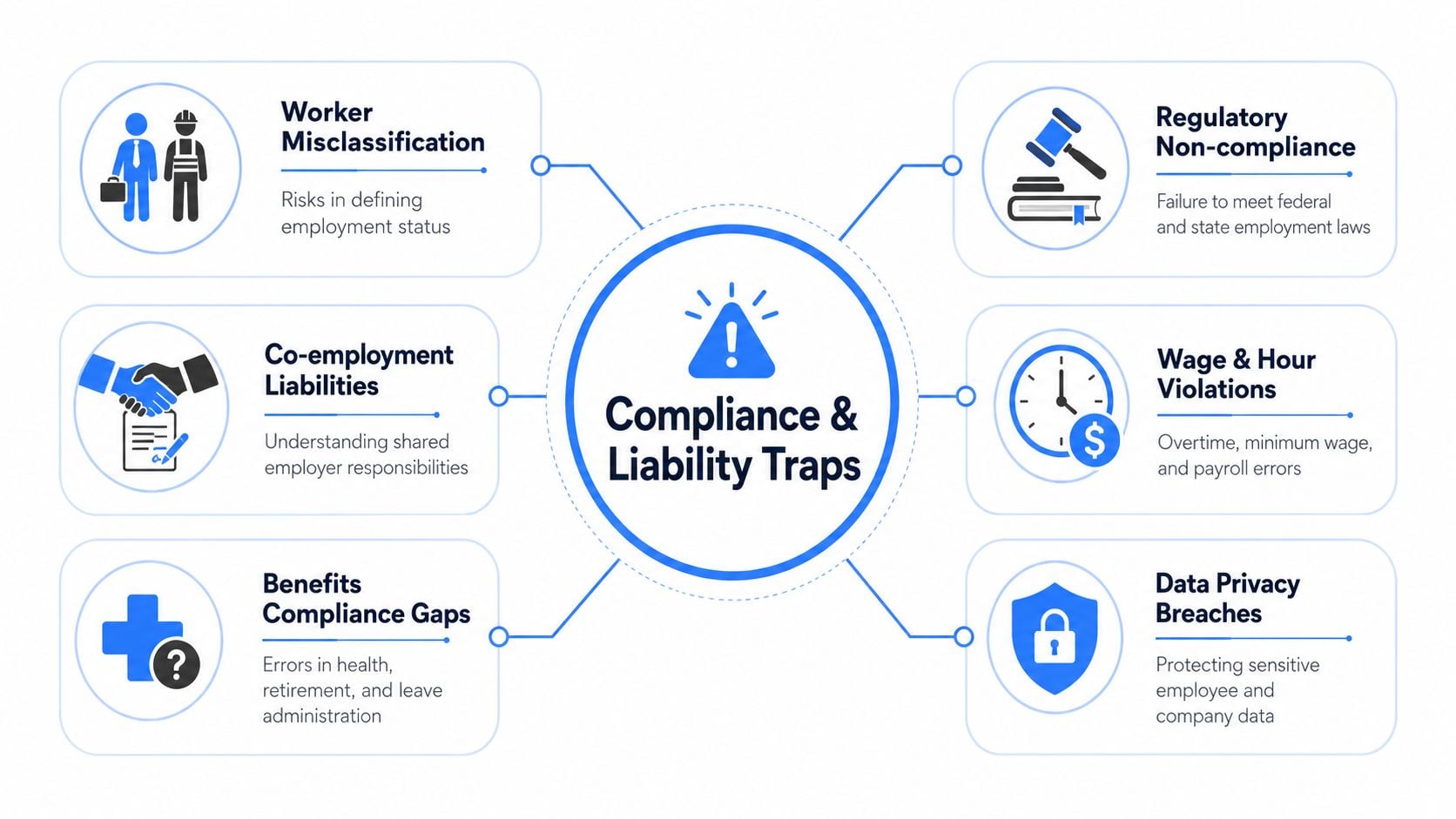
The biggest compliance mistakes happen when a company treats employee leasing and PEO co-employment as interchangeable labels. They are not. The cost of getting that wrong usually shows up later, in retirement plan testing, payroll tax disputes, workers’ compensation structure, and shared liability for employment claims.
The retirement plan rule that catches buyers off guard
The issue many guides miss is the IRS leased-employee rule under Section 414(n). If workers perform services for the client on a substantially full-time basis for at least a year, under the client’s direction, they can be treated as the client’s employees for retirement plan purposes even if another entity runs payroll. The Employee Benefits Law Group explanation of leased employee aggregation rules lays out why that matters for eligibility, coverage, and nondiscrimination testing.
Such circumstances often lead to expensive misunderstandings. A finance team sees invoices from a leasing firm and assumes those workers sit outside the client’s 401(k) testing population. Counsel reviews the service agreement and assumes co-employment language solves the issue. Neither assumption is safe.
The practical test is functional, not cosmetic. The Benefit Resources discussion of leased employees and PEOs highlights the factors practitioners check: whether the worker has been there long enough, whether the role is effectively full-time, and whether the client controls hiring, firing, pay, and day-to-day supervision. If those facts line up, the worker may count back into the client’s plan analysis.
I have seen this create two ugly outcomes. First, a company excludes leased workers from retirement plan testing and then learns too late that its plan may have coverage or nondiscrimination defects. Second, the company includes them only after the fact and discovers the plan design never fit the workforce model it was using. Both problems cost more to fix after a plan year closes.
Another company handling payroll does not automatically keep long-term leased workers outside your retirement plan risk.
For employers reviewing broader protection gaps around workplace claims, contractual risk transfer, or third-party exposures, a solid primer on employers liability cover can help frame what a service agreement does and does not protect.
Tax liability, state liability, and workers compensation
Payroll tax responsibility is another area where contract language gets more credit than it deserves. The IRS guidance on third-party payer arrangements for professional employer organizations explains how a PEO may handle withholding, payroll processing, and employment tax filings. That administrative role matters, but it does not erase the need to verify who holds legal responsibility for specific failures, how funds move, and what happens if deposits are missed.
State law can widen exposure fast. Indiana, for example, treats both the client and the lessor as legal employers of leased workers in this context, according to the Indiana compensation reference on employee leasing and PEOs. That shared-employer framework affects more than paperwork. It can shape who gets pulled into wage claims, injury disputes, and supervision-related litigation.
Workers’ compensation setup also deserves more scrutiny than buyers usually give it. Under NCCI guidance on employee leasing and PEO arrangements, separate policies may be issued for the PEO and each client, with payroll and loss data reported individually for experience rating purposes. That changes how claims history attaches, how modifiers develop, and whether a bad year follows the provider, the client, or both.
The legal exposure is operational, not theoretical. If the client directs the work, controls the site, and sets performance expectations, plaintiffs’ counsel will not care that the worker appeared on someone else’s payroll register. This review of joint employment enforcement risks is worth reading alongside any leasing or PEO agreement.
The safe approach is simple. Review the workforce model with benefits counsel, employment counsel, payroll tax specialists, and your broker before signing. If a vendor says “we employ the workers,” ask the harder follow-up question: for which obligations, under which statutes, and with what financial backstop if that position is challenged?
Matching the Right Model to Your Business Scenario
The right answer depends less on vendor labels and more on how the workforce is used. Headcount growth, assignment length, internal HR maturity, and control over benefits all change the answer.
When a PEO fits best
A multi-state growth company is usually the clearest fit. Consider a technology business with about 150 employees expanding into multiple states while trying to offer stronger benefits and centralize payroll. A PEO often makes sense because the business wants a broader operating platform, not just workers on someone else’s payroll.
Another strong fit is a company that has outgrown founder-led HR but isn’t ready to build a large internal HR and payroll team. In that situation, co-employment can reduce admin burden while preserving operational control over hiring, performance, and compensation decisions.
Decision lens: If the company wants infrastructure for payroll, benefits, compliance support, and HR administration across a permanent workforce, a PEO is usually the cleaner model than traditional leasing.
When leasing, staffing, or an ASO makes more sense
A project-based labor need points in a different direction. A construction or field services business needing a crew for one defined project may be better served by temporary staffing or a narrower leasing structure. The key is duration. If the work is finite and tied to a project timeline, a long-run co-employment platform may be more complexity than the company needs.
An ASO fits companies with stronger internal HR leadership. A business with a mature people team may want payroll processing, tax filing support, and HR administration help without entering a co-employment relationship. That model keeps more direct responsibility in-house, which some finance leaders prefer because it creates less ambiguity over who owns policy and risk.
A third scenario sits in the middle. Some firms use a leasing arrangement for a specific labor category while retaining direct employment for core staff. That can work operationally, but the company should pressure-test benefit consequences and contract economics before expanding the model into long-term workforce design. Once a “temporary” labor solution becomes a standing arrangement, the legal and cost profile changes.
How to Analyze the True Cost of Employee Leasing vs PEOs
Pricing conversations get distorted because the visible fee isn’t always the actual fee. With the leasing of employees, part of the cost may sit inside the labor rate itself. With a PEO, the fee is usually easier to spot because it’s quoted as a percentage of payroll or a per-employee charge.

Where the leasing model gets expensive
Employee leasing commonly includes setup fees ranging from $700 to $5,600 and ongoing fees averaging 3.5% to 4% of payroll, according to OEM America’s explanation of employee leasing versus a PEO. That same source gives the clearest practical example of embedded markup: a worker billed to the client at $20 per hour may receive $15 per hour, with the $5 difference covering the leasing company’s overhead and profit.
That pricing structure matters because it hides cost in plain sight. A CFO reviewing labor spend may see a reasonable hourly bill rate without realizing the provider margin is the primary administrative charge. For long-term roles, that can become less efficient than a PEO arrangement that charges a visible administrative fee without reducing the worker’s underlying base wage in the same way.
A cleaner comparison asks for the all-in annual employer cost under each model. Include setup charges, payroll administration, tax handling, workers’ compensation treatment, benefit administration, and any labor-rate markup. If one proposal quotes a fee and another quotes a loaded pay rate, they are not yet comparable.
What to ask before comparing proposals
Use a short audit list before signing or renewing:
- Show the margin mechanics: Ask whether the provider earns revenue through payroll percentage, per-employee billing, labor-rate spread, or a mix of all three.
- Separate implementation from recurring cost: Setup fees can be modest or material depending on scope. They shouldn’t be buried in a broad “onboarding” label.
- Trace every pass-through item: Taxes, workers’ compensation, benefits admin, garnishments, and year-end processing should be shown separately if they’re not included.
- Model the contract term: A price that looks acceptable in year one can become expensive if renewals allow broad fee increases.
For companies trying to normalize provider quotes and see what belongs in a full HR outsourcing budget, this guide on how much it costs to outsource HR is a helpful benchmark.
Weighing the Strategic Benefits and Hidden Risks
The strategic upside is real, but it gets overstated when buyers blur employee leasing, staffing, and PEO co-employment into one bucket. That shortcut creates bad decisions. The biggest cost is not usually service frustration. It is signing a model that looks efficient on an invoice and then discovering it changes tax, benefit, retirement plan, and control assumptions in ways leadership did not price in.
A well-run PEO arrangement can give a smaller employer better benefit buying power, cleaner payroll administration, and more consistent HR process than the company could build internally at its current scale. That matters in recruiting. It also matters in finance because fewer manual fixes usually means fewer payroll errors, fewer notice responses, and less management time spent patching routine HR work.
Provider quality still varies widely. One practical advantage of a CPEO is that the certification framework imposes a higher financial threshold than the market average. For a CFO or controller, that does not eliminate risk, but it can reduce concern about payroll tax remittance discipline and provider solvency. The contract still matters. Buyers should review indemnities, tax responsibility language, and service carve-outs with the same care they apply to a lending agreement. This PEO master service agreement checklist is a useful tool for that review.
The hidden risk sits elsewhere. If the workforce model is mislabeled, the company can make the wrong calls on retirement plan testing, benefit eligibility, and employer aggregation. That is where the IRS leased employee rules under Section 414(n) become a serious issue. A business may assume workers sit outside its plan design because another entity is cutting payroll. In some cases, that assumption fails, and the employer is left dealing with plan qualification problems after the fact. Those fixes are expensive, time-sensitive, and usually discovered during an audit, transaction diligence, or annual retirement plan review.
I see this most often in companies with long-term assigned workers who function like regular employees but were contracted through a leasing or staffing structure for convenience. Operations treats them as part of the core team. Finance books a vendor invoice. HR excludes them from benefit and retirement analysis. Those three views do not always line up legally.
The operational trade-off is control. Some employers are comfortable fitting their processes into a provider’s payroll calendar, onboarding workflow, and HR ticket model. Others are not. If the business needs custom leave practices, frequent off-cycle changes, acquisition integration, or tight coordination between legal, HR, and payroll, the provider can become a bottleneck rather than a relief valve.
Employee experience usually exposes the mismatch first. Workers do not care which entity handles payroll taxes. They care whether problems get fixed quickly, whether benefits are explained clearly, and whether their manager knows who owns the issue. Confused ownership creates distrust fast, especially during onboarding, leave events, workers’ compensation claims, or terminations.
A useful comparison comes from other outsourced functions. A buyer evaluating a service partner should test reporting access, escalation paths, and handoff clarity, not just the sales demo. The same discipline shows up in this guide to outsourcing data analytics, and it applies here as well.
The best outcome is not “outsource more” or “keep everything in-house.” It is choosing a model whose legal structure, financial exposure, and operating limits match the way the workforce is used. If the provider cannot explain where co-employment ends, where your retained liability begins, and how leased-worker treatment affects retirement plan analysis, the strategic benefit is weaker than it looks.
Your Evaluation Checklist and Negotiation Playbook
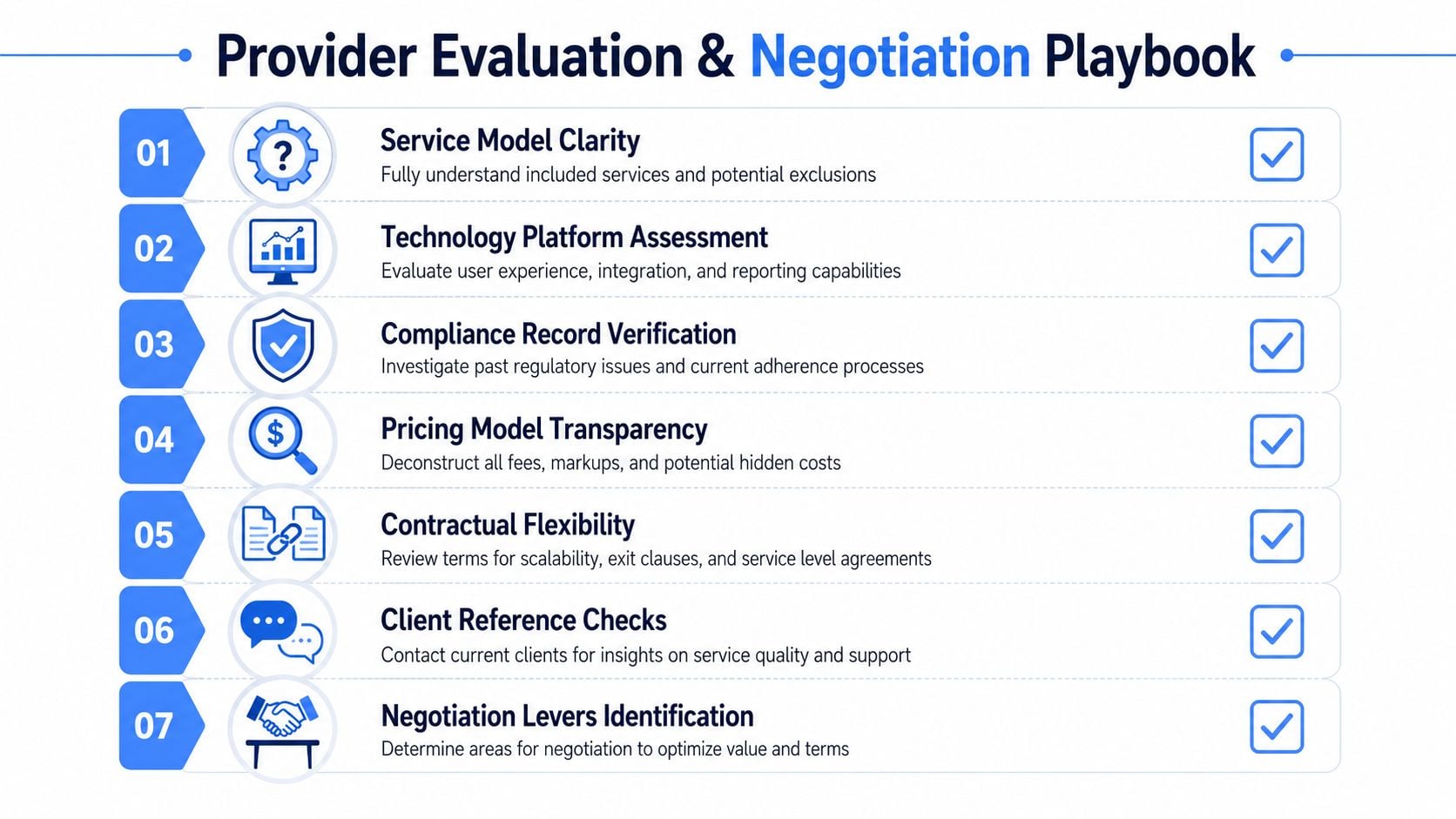
A polished proposal is not enough. Buyers need to review the service model, legal structure, and contract mechanics with the same discipline they’d apply to debt documents or insurance programs.
Provider checklist
Use this list before moving to contract redlines:
- Confirm the model: Is the provider offering true co-employment, admin-only support, staffing, or a leasing arrangement with a different legal structure?
- Review industry fit: Ask for examples of clients with similar workforce patterns, especially if the company has multi-state hiring, field labor, or regulated roles.
- Test the technology: Have payroll, HR, and finance users see the platform, not just the buyer. Reporting friction usually shows up after implementation.
- Check compliance process: Ask who handles tax notices, wage claims, workers’ compensation coordination, and benefit eligibility escalations.
- Speak with current clients: The useful questions are operational. How are issues escalated. How often does the account team change. What happens during renewal.
Ask each reference what went wrong in the first six months. The answer is usually more valuable than what went right.
For contract review, this PEO master service agreement checklist is a practical tool to keep the legal and pricing points organized.
Contract terms worth negotiating
One contract issue gets underestimated constantly. Leased employee contracts often contain vague indemnity language and weak limits on future fee increases. The Complete Payroll Solutions article on employee leasing highlights why buyers should negotiate rate locks, implementation credits, and clear renewal protections before signing.
Focus negotiations on the clauses that change economic value over time:
- Annual fee increases. Ask for a defined cap or a fixed pricing period.
- Termination terms. Clarify notice periods, implementation cost clawbacks, and any early-exit penalties.
- Indemnification. Don’t accept broad language that sounds protective but leaves defense-cost responsibility unclear.
- Auto-renewal mechanics. Require clear renewal notice windows and pricing disclosure before the renewal deadline.
- Service levels. If payroll accuracy, tax filing, or support response time matters, tie expectations to measurable commitments.
- Data access and transition support. Make sure the company can retrieve payroll and employee records cleanly if the relationship ends.
The strongest negotiation posture comes from knowing which terms affect long-run cost and which terms are mostly cosmetic. Many buyers spend too much time debating setup fees and not enough time on renewal economics.
PEO decisions are easiest to get wrong when every provider presentation sounds the same. PEO Metrics helps companies compare PEO options side by side, benchmark pricing and benefits, flag contract risk, and negotiate stronger terms before they sign or renew.
