
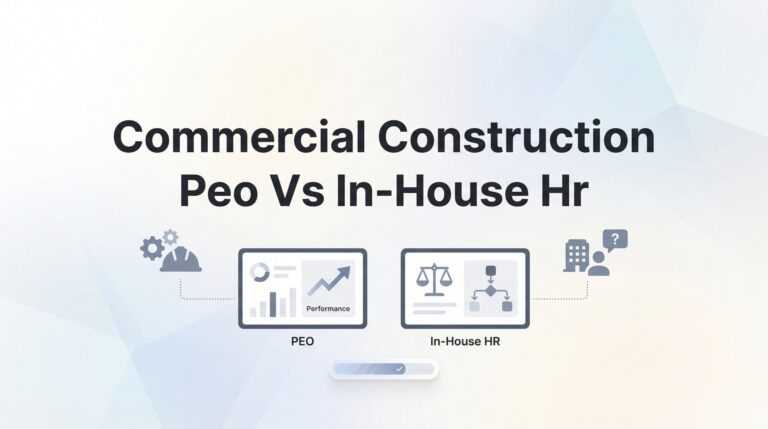
Commercial construction companies face unique HR challenges including multi-site crew management, complex workers’ comp classifications, seasonal staffing, and strict OSHA compliance. This guide examines seven critical decision factors to help you determine whether a Commercial Construction PEO vs In-House HR solution better fits your operation, comparing cost structures, risk management, and operational control without generic advice—just practical tradeoffs specific to construction busine…
Residential construction companies with 50 employees face unique HR challenges including workers’ comp exposure, OSHA compliance, and multi-site payroll complexity that generic solutions can’t handle. This guide outlines seven strategic evaluation criteria for selecting a residential construction PEO for 50 employees, focusing on operational realities like certified payroll capabilities, construction-specific class codes, and seasonal workforce flexibility rather than just benefits pricing.
Roofing contractors face unique HR challenges including high workers’ comp costs, seasonal staffing fluctuations, and OSHA compliance requirements that generic solutions can’t address. This guide evaluates the best PEO for roofing companies based on construction industry expertise, workers’ comp management, multi-state crew support, and pricing transparency to help you find a partner that understands experience mods, jobsite safety documentation, and the seasonal nature of roofing operations.
Finding the right commercial construction PEO for 5 employees requires a different approach than larger companies, focusing on workers’ comp rates, flexible contracts, and avoiding enterprise-level services you don’t need. This guide provides seven targeted strategies to help micro-sized construction crews secure affordable PEO services without the administrative burden designed for 50+ employee operations, ensuring you get essential HR and safety compliance without paying for unnecessary fea…

Commercial construction companies need specialized PEO providers that understand industry-specific challenges like fluctuating crew sizes, multi-state compliance, high workers’ comp exposure, and OSHA requirements—not generic HR solutions. This guide evaluates the top commercial construction PEO providers based on their workers’ compensation programs, jobsite safety support, project-based payroll capabilities, and proven track records serving contractors navigating prevailing wage laws and un…
When your commercial construction company reaches 15 employees, choosing the right Commercial Construction PEO for 15 Employees becomes critical for managing complex payroll classifications, workers’ comp exposure, and multi-site crew coordination. This guide presents seven essential strategies to help contractors select a PEO that understands prevailing wage requirements, job-specific employee coding, and the unique compliance challenges of running multiple crews across different project types.
Commercial construction companies with 25 employees face a critical decision point where DIY HR becomes unsustainable but a full department isn’t justified. The right Commercial Construction PEO for 25 Employees can strategically address rising insurance costs, OSHA compliance, and certified payroll requirements while maintaining bid competitiveness, but choosing a provider that genuinely understands construction-specific challenges is essential to avoid costly operational complications.
Commercial construction companies with 50 employees face a critical decision point where informal HR practices no longer work, but a full in-house department isn’t justified. A commercial construction PEO for 50 employees can address workers’ comp exposure, OSHA compliance, and multi-trade coordination challenges—but only if the provider genuinely understands construction-specific needs like claims management, certified payroll, and job-costing integration rather than offering generic HR solu…
Commercial construction companies with 100 employees face unique HR challenges that generic PEOs can’t address—from managing workers’ comp experience mods and OSHA compliance to handling multi-state payroll complexities. This guide provides seven targeted strategies to help you evaluate and select a Commercial Construction PEO for 100 Employees that understands jobsite realities, offers industry-specific safety programs, and delivers benefits tailored to construction workers rather than desk-…
Finding the right PEO for residential construction companies requires specialized expertise in high-risk workers’ comp classifications, OSHA compliance, and payroll systems that handle prevailing wage requirements. This comprehensive guide evaluates eight PEO providers based on their actual construction industry experience, safety program support, and ability to manage the unique challenges of crews working across multiple job sites—going beyond generalist providers to identify those who trul…

Residential construction companies face unique HR challenges including workers’ comp claims, OSHA compliance, prevailing wage requirements, and seasonal workforce fluctuations that generic PEOs can’t handle. This guide ranks the eight best PEOs for residential construction companies based on their ability to manage construction-specific risk pools, certified payroll for government contracts, and the operational realities of building homes across multiple job sites.
Residential construction companies face a critical decision between PEOs and payroll companies that impacts workers’ comp costs, liability exposure, and compliance management. This comparison breaks down 8 top providers for 2026, helping contractors choose based on their workers’ comp modifier, administrative needs, and whether they need full HR co-employment or just payroll processing with certified payroll and prevailing wage capabilities.