
Healthcare practices struggle with rising labor costs not because they overpay employees, but because they lack the purchasing power and administrative infrastructure to negotiate better rates on benefits, workers’ comp, and insurance. This guide shows how partnering with a Professional Employer Organization enables labor cost optimization using PEO for healthcare practices by accessing enterprise-level pricing and streamlining HR operations that small to mid-sized practices can’t achieve ind…
When your PEO delivers one consolidated invoice for multiple business units, you lose visibility into true unit-level labor costs—making it impossible to identify which locations are profitable and which are draining resources. This strategic blind spot prevents informed decisions about expansion, staffing, and operations, potentially causing you to subsidize underperforming units or mistakenly cut profitable ones without a proper PEO cost allocation across multiple business units financial i…
Professional services firms with low-risk workforces often overpay for insurance due to small group pools and volatile renewals. This guide provides a systematic approach to insurance cost control using PEO partnerships, covering how to audit current spend, evaluate whether PEO pooling fits your firm’s risk profile, negotiate effectively, and measure actual savings—helping professional services firms escape subsidizing higher-risk industries while achieving more stable premiums through larger…
When catastrophic health claims hit—like a $400,000 leukemia treatment—most PEO clients are surprised they’re not financially devastated. That’s because of stop loss coverage, a hidden layer of protection that shields businesses from massive medical costs. Understanding the PEO stop loss coverage structure explained here is critical: it’s what separates stable renewals from 40% rate shocks and determines whether your risk pool remains financially viable when expensive claims occur.
When the Department of Labor determines that two businesses share employer responsibilities over the same workers, both can be held fully liable for wage violations—even if only one made the mistake. DOL joint employment enforcement risks have intensified for companies using PEOs, staffing agencies, or contractor arrangements, with potential penalties reaching six figures in back wages and damages for violations you didn’t directly commit.
Before signing with a PEO, understanding their regulatory capital requirements is critical to protecting your business from financial disaster. These requirements ensure PEOs maintain sufficient reserves to handle payroll taxes, benefits premiums, and workers’ compensation—safeguarding you from scenarios where your PEO collects funds but fails to forward them to the IRS or insurers, leaving you liable for potentially massive tax debts and compliance violations.
Multi-location retailers face unique challenges when transitioning to a new PEO, including navigating different state wage laws, varying workers’ comp requirements, and seasonal staffing fluctuations across locations. This tactical guide provides specific steps for PEO transition planning for multi-location retailers—from conducting comprehensive audits of your current setup to executing phased rollouts that protect store operations during peak selling periods while avoiding payroll errors an…
When you’re adding 10+ employees monthly, manual onboarding wastes 8-15 hours per hire on repetitive data entry and form chasing. This guide shows high-growth companies how to implement PEO onboarding automation for high growth companies that scales effortlessly—handling 50 new hires as smoothly as 5 by building automated workflows that reclaim your team’s time and eliminate bottlenecks in your existing PEO system.
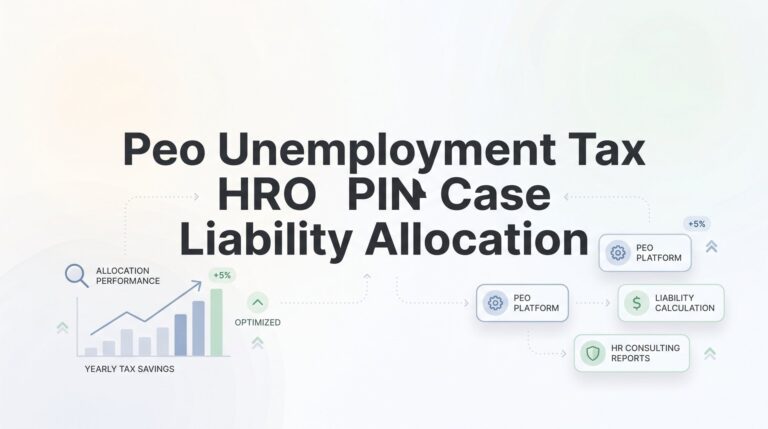
When you partner with a PEO, your unemployment insurance costs may not reflect your actual claims experience due to how the PEO allocates unemployment tax liability across its client base. Understanding PEO unemployment tax liability allocation methods before signing a contract is critical—the difference between pooled rates and experience-rated allocation can mean thousands of dollars annually, especially if your business has low turnover but you’re subsidizing higher-risk companies in the s…
Staffing agencies face unique challenges when evaluating PEO partnerships due to high worker turnover, multiple job classifications, and complex co-employment relationships that generic ROI calculators don’t address. This framework provides staffing-specific PEO ROI analysis by examining workers’ comp exposure, unemployment insurance costs, and compliance complexity across state lines, helping agencies determine whether outsourcing HR functions makes financial sense given their already-tight …
When your PEO’s billing doesn’t align with your general ledger, financial reporting becomes a monthly reconciliation nightmare. This guide walks you through building a PEO payroll consolidation framework for financial reporting compliance that solves timing mismatches, maps PEO invoice categories to your chart of accounts, and creates the documentation trail your auditors demand—eliminating the gap between co-employment operations and accurate financial statements.
Restaurant groups pay different PEO rates than typical businesses due to unique operational challenges like high turnover, tipped wages, frequent workers’ comp claims, and multi-state compliance issues. Understanding the PEO cost structure for restaurant groups helps multi-unit operators evaluate quotes accurately, negotiate effectively, and avoid overpaying for services that don’t align with their specific operational needs and risk profile.