

This article walks through a practical cost modeling approach for evaluating the real PEO effect on gross margin in service businesses, showing how PEOs simultaneously reshape health insurance, workers’ comp, payroll taxes, and HR overhead costs. Rather than focusing solely on admin fees, it demonstrates how these cost shifts flow through your P&L to either genuinely improve margins or simply redistribute dollars across expense categories.
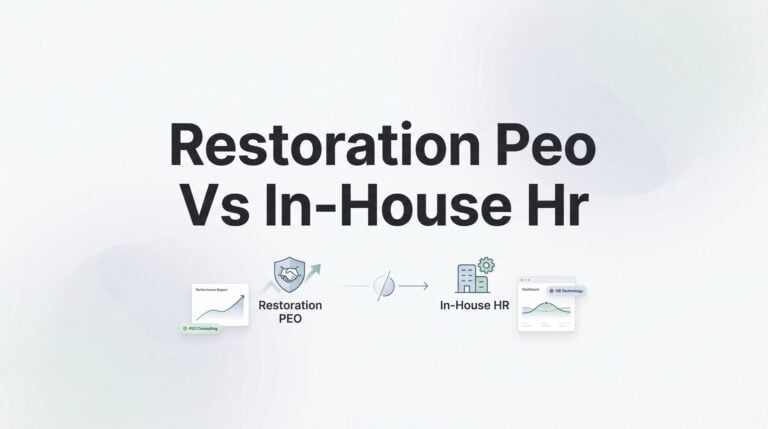
Restoration companies face unique HR challenges—hazardous worksites, 24/7 crew deployments, and volatile headcount—that make the Restoration PEO vs In-House HR decision far from straightforward. This guide delivers seven practical decision frameworks tailored specifically to restoration business owners, helping them evaluate workforce size, risk exposure, multi-state operations, and cost trade-offs to choose the HR model that actually fits how their business runs.
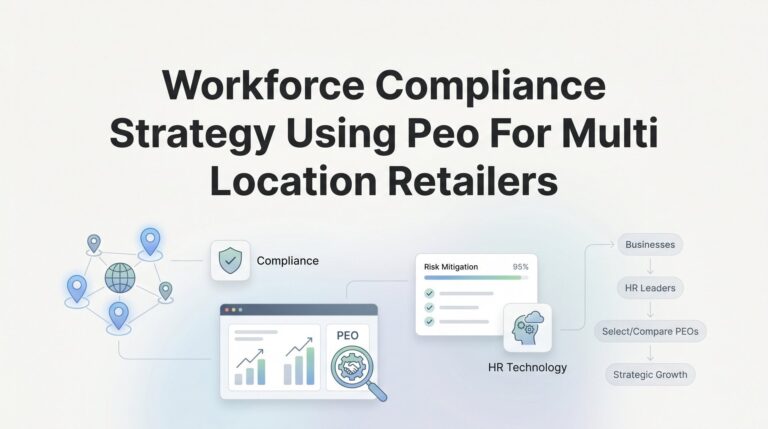
Multi-location retailers managing employees across multiple states face compounding compliance risks from overlapping federal, state, and local labor laws that shift constantly. A workforce compliance strategy using a PEO for multi-location retailers provides the infrastructure, expertise, and co-employment framework needed to stay ahead of wage and hour liability, policy gaps, and jurisdiction-specific obligations before they become costly legal problems.
A Florida employer shopping for a PEO usually sees the same pattern. A national provider promises buying power, a regional firm promises…
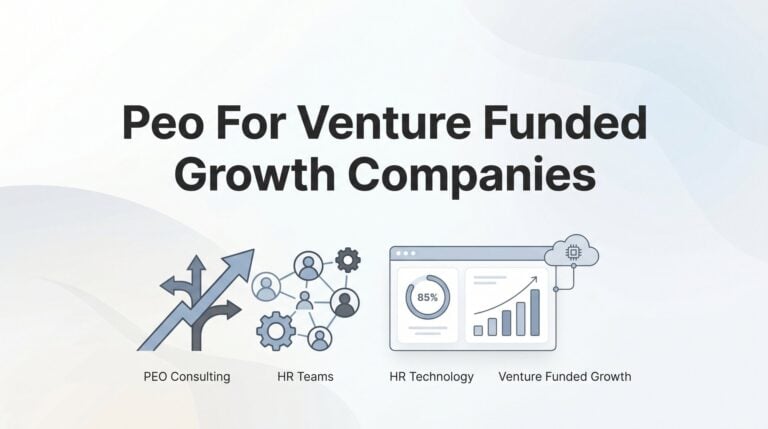
PEO for venture-funded growth companies addresses a critical gap for founders navigating rapid post-funding scaling — from multi-state payroll to competitive benefits — that standard HR solutions weren’t built to handle. This guide covers what high-growth startups actually need to evaluate when choosing a PEO, including speed of state registration, headcount scalability, and infrastructure that supports aggressive hiring timelines without slowing momentum.
Understanding peo catastrophic claim exposure mitigation financial impact analysis is critical for business owners who focus solely on monthly fees when evaluating PEO arrangements. This guide explains how a single seven-figure workers’ comp or health claim can trigger mid-contract repricing and push unexpected financial liability onto your balance sheet, and walks through the analysis and mitigation strategies needed to protect your business before you sign.
The top restoration PEO providers stand out by offering specialized workers’ comp expertise across multiple NCCI class codes, flexible headcount management for disaster-driven staffing surges, and multi-state compliance support — capabilities that generic PEOs often lack. This guide evaluates eight PEO solutions specifically suited to the unique workforce and safety demands of restoration companies.
PEO payroll consolidation for financial reporting requires a structured financial impact analysis to ensure your income statement remains accurate after transitioning to a PEO arrangement. This guide walks through how PEO invoices restructure your P&L, how to build a consolidation framework that translates bundled PEO costs into clean financial data, and what the analysis reveals for better decision-making.
Security guard companies face uniquely complex payroll challenges—multi-site rotations, state-crossing schedules, armed versus unarmed worker classifications, and non-standard overtime rules. This tactical guide walks security company owners through how to properly evaluate, select, and implement Security Guard PEO Payroll Services to handle these complexities without creating new compliance headaches in the process.
Small restoration companies seeking a Restoration PEO for 5 Employees face a unique challenge — too large to ignore compliance and workers’ comp risks, yet too small for many providers to serve cost-effectively. This guide outlines five practical strategies to help five-person restoration contractors identify PEO partners who understand high-risk trade classifications, offer flexible contracts, and deliver real value without overpriced or mismatched coverage.
Labor burden restructuring through a PEO model compliance framework involves more than cost repackaging — it requires understanding the legal and regulatory mechanics that determine whether a co-employment arrangement genuinely shifts your fully loaded labor costs or simply adds a new fee layer. This deep-dive breakdown helps business owners evaluate PEO structures with the compliance clarity needed to make informed decisions about payroll taxes, workers’ comp, and benefits administration ove…
Switching security guard companies to a PEO can consolidate payroll, workers’ comp, benefits, and compliance into one streamlined relationship — but the transition requires careful planning around industry-specific challenges like guard licensing, elevated workers’ comp classifications, and employer-of-record contract language. This step-by-step guide walks security company owners through the entire process, addressing the friction points that generic PEO onboarding guides typically overlook.