
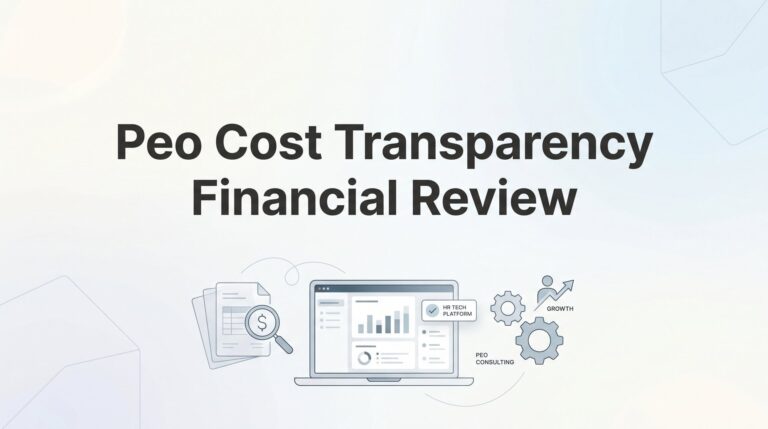
A PEO cost transparency financial review helps business owners uncover hidden fees buried in admin charges, insurance markups, and workers’ comp spreads that often go unnoticed in standard monthly invoices. This guide provides the documents, questions, and structured framework needed to understand exactly what you’re paying for and whether your PEO is delivering fair market value.
Understanding PEO service customization structure helps business owners move beyond one-size-fits-all assumptions and negotiate smarter contracts. This guide breaks down how providers organize offerings into tiers, modules, and add-ons, revealing where businesses have real flexibility in what they pay for and control, and where customization options are more limited than sales presentations suggest.
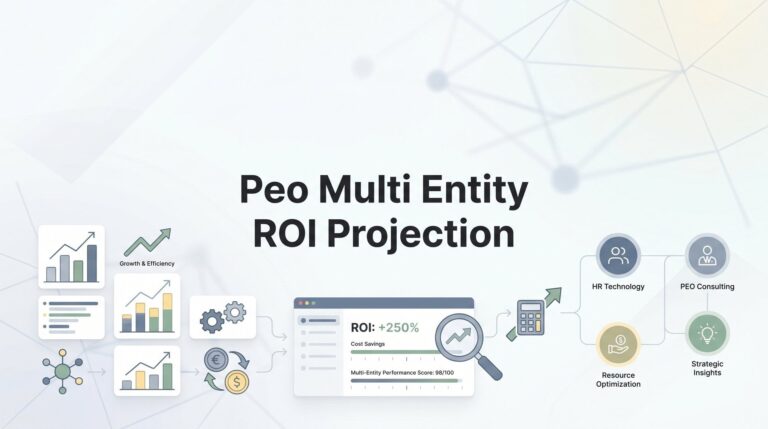
Building an accurate PEO multi-entity ROI projection requires analyzing each business unit separately, since generic provider estimates fail to account for varying headcounts, state compliance obligations, workers’ comp profiles, and pricing tiers across entities. This guide walks multi-entity operators through a structured, entity-by-entity framework to identify where a PEO genuinely delivers savings, where it doesn’t, and where hidden costs can quietly erode returns.
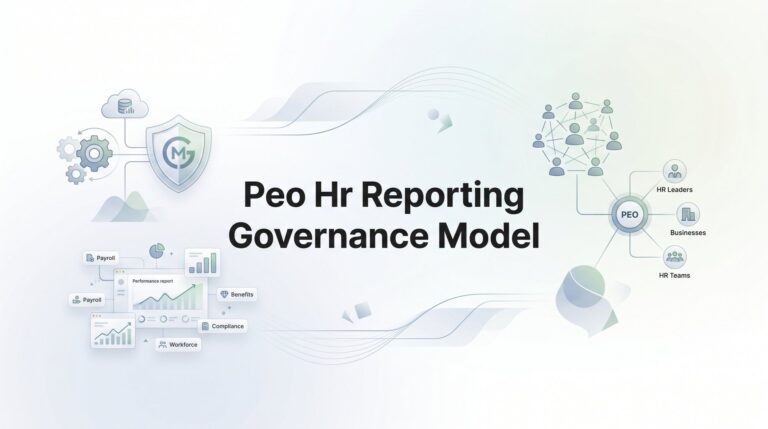
A PEO HR reporting governance model defines who owns workforce data and who bears accountability when numbers from your PEO portal and internal systems don’t align—a common but preventable problem in co-employment arrangements. This guide breaks down how to establish clear data ownership, reconciliation protocols, and reporting responsibilities so businesses can confidently manage headcount, compliance, and board-level reporting without costly discrepancies.
Using a PEO with decentralized HR teams creates real structural tension, since PEOs centralize by design while distributed HR models exist to preserve local expertise and decision-making speed. This guide examines what actually works—and what breaks down—when organizations with regional HR authority, division-level compliance ownership, and site-specific benefits try to layer co-employment onto an already functioning distributed structure.

Using a PEO compliance gap cost estimator helps business owners calculate the real financial exposure from penalties, legal risk, and operational drag before evaluating PEO pricing. This practical guide walks you through estimating your current compliance costs across key categories so you can make a grounded, data-backed decision about whether partnering with a PEO actually delivers a positive return.
Running a PEO with an internal compensation team doesn’t have to create redundancy — it requires deliberate role separation. A PEO handles payroll execution, tax administration, and compliance infrastructure, while your internal comp team retains ownership of pay philosophy, salary bands, and equity strategy, allowing both functions to operate efficiently without duplicating work or creating conflicting data sources.

Projecting PEO employment litigation costs requires understanding how a co-employment arrangement actually shifts your legal exposure across wrongful termination, wage disputes, and discrimination claims—not just what the contract promises. This guide provides a practical framework for building working cost estimates you can use to compare PEO proposals, set legal reserves, and identify where your real financial risk lives before a demand letter forces the calculation.
The PEO workforce planning coordination model describes how co-employment creates a dual-timeline hiring process where your decisions trigger separate PEO workflows for payroll, benefits, and compliance. Understanding this coordination layer helps businesses prevent operational bottlenecks and align their headcount planning with the realistic timelines that emerge once a PEO partner is involved in onboarding new employees.
A PEO hybrid workforce governance model defines clear ownership boundaries when your team spans co-employed staff, contractors, and in-house executives—because your PEO’s service agreement only covers part of the picture. This guide walks through how to map compliance responsibilities, close governance gaps, and reduce legal exposure across every worker classification in your organization.
Understanding your PEO insurance reserve impact is critical to avoiding overpayment on workers’ comp coverage — yet most business owners never examine this number. This step-by-step guide walks you through a practical six-step process using a PEO insurance reserve impact calculator approach to evaluate whether your reserves are reasonable, how they affect your experience modification rate, and where you have leverage to push back on costs.
PEO strategic HR advisory layering is the practice of supplementing standard PEO services with dedicated strategic HR expertise when administrative support alone no longer meets your organization’s growing needs. This approach helps scaling businesses navigate complex challenges like multi-state expansion, leadership development, and workforce strategy that fall outside a typical PEO’s transactional scope.