
PEO for manufacturing advanced workers comp structuring goes beyond rate shopping — it requires careful evaluation of class codes, experience mod rates, and employee classifications to avoid costly audit adjustments. This practical walkthrough covers how manufacturing businesses can properly negotiate and implement a PEO workers’ comp structure that manages high-risk environments effectively without creating compliance or financial problems down the line.

A PEO HR outsourcing maturity framework helps businesses accurately assess their current HR capabilities before selecting a PEO provider, preventing costly mismatches between the support they pay for and what they actually need. Rather than comparing vendor pitches, companies start with an internal audit of their HR evolution to identify the right level of outsourced support.

The PEO hybrid HR cost model creates a complex pricing structure that most businesses never fully map out, leaving hidden costs on both sides of the service split. This guide breaks down what companies actually pay when dividing HR responsibilities between a PEO and internal staff, exposing where bundled margins and loaded in-house costs quietly accumulate.
A PEO long-term cost savings projection built on validated assumptions—not just first-year quotes—reveals whether a PEO arrangement genuinely delivers value over three to five years by accounting for insurance renewal trends, administrative labor displacement, compliance risk reduction, and hidden fees that quietly erode savings. This guide provides a realistic framework for businesses to evaluate true PEO costs before and after signing.
A PEO oversight committee governance model provides businesses with a structured internal accountability framework to actively manage their co-employment relationship, preventing costly gaps like unresolved compliance penalties or surprise benefits rate increases. This guide explains how to build the right committee structure, assign clear ownership roles, and establish review cadences that keep your PEO partnership performing as intended.
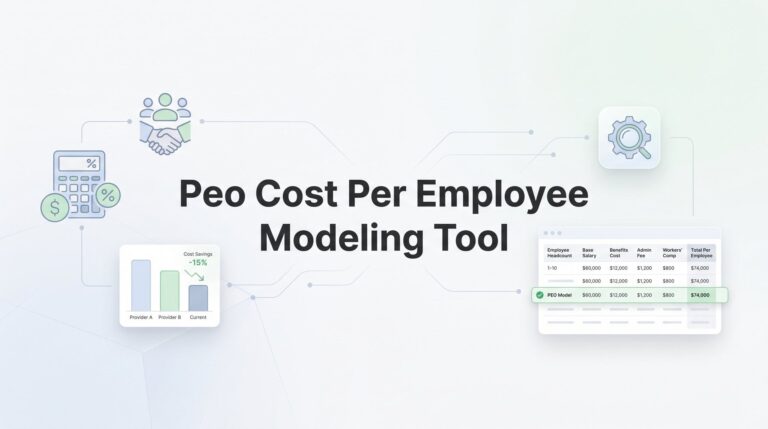
Building an accurate PEO cost-per-employee modeling tool before signing a contract helps business owners avoid invoice surprises by mapping every fee layer — from admin charges and workers’ comp markups to benefits pass-throughs and payroll tax handling. This guide walks through creating a practical spreadsheet framework that reveals the true all-in cost of PEO services, giving HR leaders and business owners a clearer basis for comparing providers and negotiating renewals.
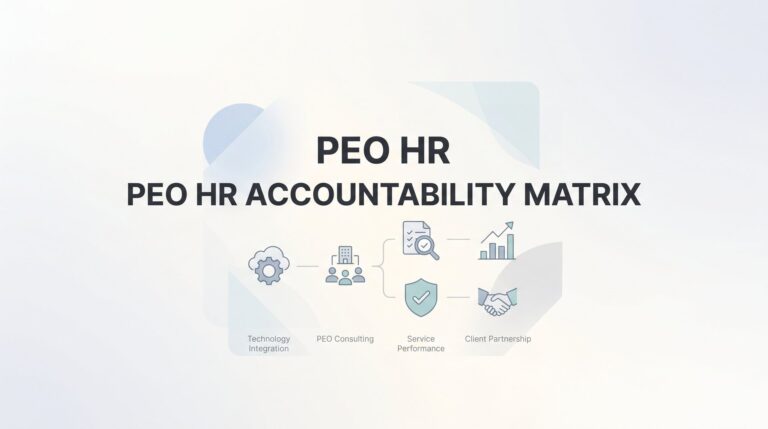
A PEO HR accountability matrix clarifies exactly who owns each HR responsibility in a co-employment relationship, preventing the costly gaps that occur when businesses and their PEO both assume the other party is handling compliance tasks like COBRA notices, terminations, and payroll tax filings. This practical framework helps companies translate vague service agreement language into a clear operational map of shared employer duties.
A PEO net present value calculator helps businesses move beyond simple monthly fee comparisons by collapsing multi-year costs—including rate escalations, workers’ comp premiums, and benefit renewals—into a single comparable number in today’s dollars. This guide walks through building a working NPV model so you can accurately evaluate PEO providers over a three-to-five year horizon and identify which option is truly cheaper long-term.
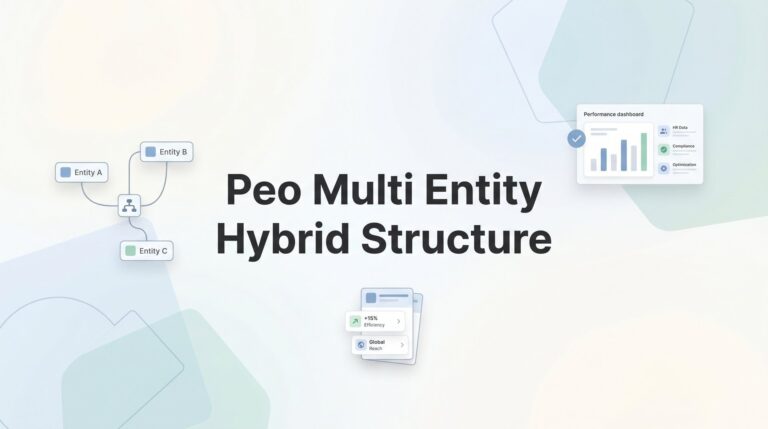
A PEO multi entity hybrid structure makes strategic sense for holding companies, franchise groups, and PE portfolio firms that can’t fit cleanly into a single PEO agreement. This approach lets businesses assign different entities to different workforce models—PEO, ASO, or self-administered—based on size, risk classification, geography, and operational needs, rather than forcing a one-size-fits-all solution that creates coverage gaps or unnecessary cost.
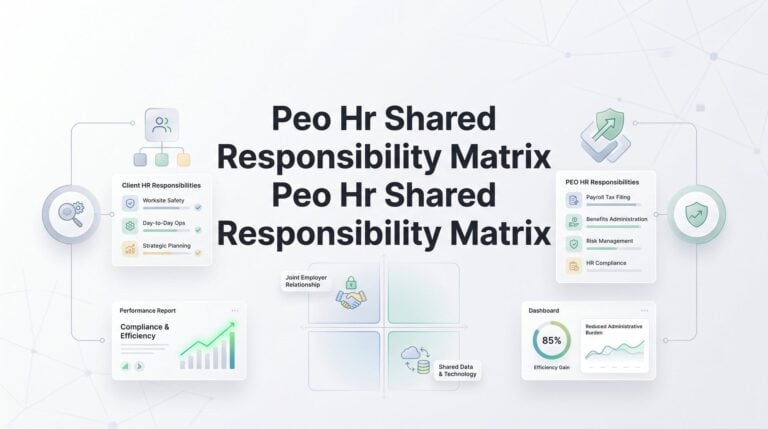
A PEO HR shared responsibility matrix closes the gap between what co-employment contracts promise and what actually happens when real HR situations arise. This guide maps every meaningful HR function—from unemployment claims to OSHA logs—to the PEO, your company, or both, clarifying who decides, who executes, and who absorbs liability when things go wrong.
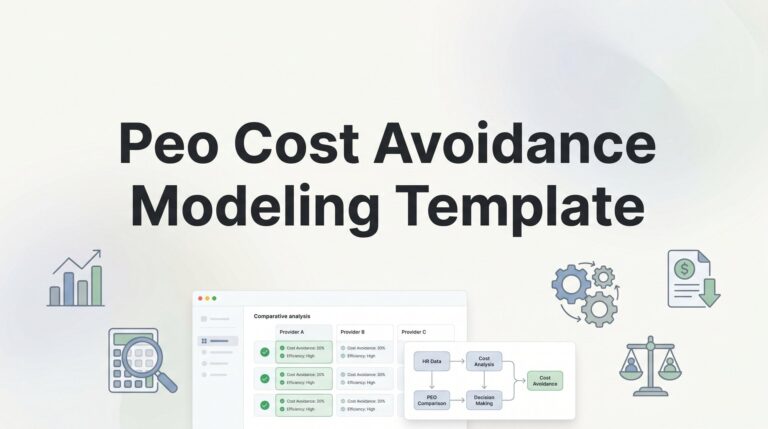
A PEO cost avoidance modeling template helps businesses move beyond simple price comparisons to quantify the hidden costs of not using a PEO—including compliance penalties, HR time losses, and workers’ comp exposure. This guide walks through building a rigorous, unbiased model from scratch that captures real financial risk over a 12-to-36-month horizon.
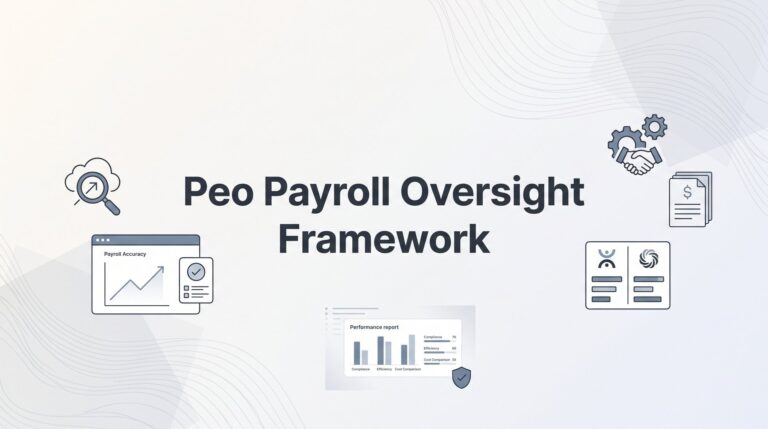
A PEO payroll oversight framework gives business owners the structured checkpoints and reconciliation routines needed to verify accuracy and maintain accountability even after handing off payroll execution to a PEO. Because the IRS holds employers responsible for withholding errors and misclassifications regardless of who processes payroll, this framework helps catch mistakes early, protect against compliance liability, and give your finance team the visibility they need.