
Two PEO quotes can look nearly identical at first glance. Same per-employee number, same sales pitch, same promise to “simplify HR.” Then…
A finance lead opens a PEO proposal expecting a clean fee summary and gets a spreadsheet instead. One tab shows payroll-based admin…
Auto dealerships face a uniquely complex PEO pricing landscape driven by mixed workforce compositions, multiple workers’ comp classifications, and varied compensation structures that standard PEO quotes rarely reflect accurately. This guide breaks down the real cost drivers behind Auto Dealerships PEO Pricing & Cost Structure — including what dealers can control, where costs hide, and when a PEO may not be the right financial fit.
At 50 employees, auto repair shops face real HR and compliance overhead without the budget for in-house infrastructure — making a well-matched PEO a high-value solution. This guide walks shop operators through seven practical strategies for evaluating Auto Repair PEO for 50 Employees options, covering pricing thresholds, industry-specific compliance, and how to avoid generic providers that don’t understand the trade.
Auto dealerships face uniquely complex workforce challenges — from commission-based pay and high turnover to multi-state compliance and varied workers’ comp classifications. This guide ranks the top auto dealerships PEO providers that are purpose-fit for the dealership environment, not just generally well-reviewed platforms.
Auto dealerships carry unusually complex workers’ compensation risk, with technicians, lot porters, detailers, and desk staff all under one entity. This guide breaks down how a PEO workers’ compensation program is structured for auto dealerships — what makes it work, where it can go wrong, and what owners should verify before signing.
At 100 employees, an auto repair operation faces a distinct HR inflection point — too large for informal management, too small for a full internal department. This guide delivers seven industry-specific strategies for evaluating and maximizing an Auto Repair PEO for 100 Employees, covering workers’ comp exposure, flat-rate pay compliance, and benefits competitive enough to retain top technician talent.

A finance lead often reaches the same point at the wrong time. The estimating team has one spreadsheet, the project manager has…
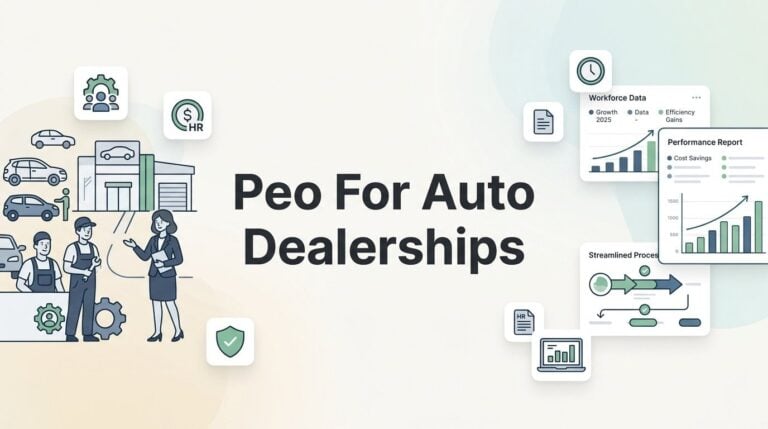
Auto dealerships manage one of the most complex workforce mixes in any industry — commissioned salespeople, certified technicians, F&I managers, and variable-shift lot staff — often across multiple locations. This guide breaks down seven specific ways a PEO for auto dealerships can reduce operational burden, control workers’ comp costs, and keep your HR infrastructure ahead of regulatory risk.
At 50 employees, auto dealerships face a distinct HR inflection point where generic PEO guidance falls short. This guide delivers seven dealership-specific strategies for evaluating a PEO — covering variable compensation structures, workers’ comp classifications, F&I compliance exposure, and the pricing mechanics that determine whether a PEO genuinely makes financial sense for your roster.
A 15-employee auto dealership carries a surprisingly complex HR and compliance footprint — mixed roles, variable pay, and layered regulations that a PEO can help manage. This guide breaks down seven practical strategies for getting genuine value from a PEO at the 15-person mark in a dealership setting, without overpaying or locking into the wrong contract.
Running a 5-person auto dealership presents unique tradeoffs when evaluating a PEO — higher per-head costs, narrower benefits savings, and compliance gaps that generic overviews ignore. This guide walks through seven practical strategies tailored to the Auto Dealerships PEO for 5 Employees decision, covering workers’ comp, commission pay structures, and how to assess providers without getting oversold.