
This PEO HR outsourcing ROI case study guide shows businesses how to build their own independent measurement framework rather than relying on provider-supplied numbers. It walks through the cost categories that matter most, common measurement blind spots, and a practical before-and-after analysis structure to determine whether your PEO relationship is genuinely delivering financial returns or simply feels like it is.
Discover the top PEO vendor consolidation savings calculators of 2026, evaluated for transparency and real-world accuracy across key cost variables like admin fees, benefits markups, and technology overlap. This guide helps HR leaders and business owners model exactly how much they could save by consolidating payroll, benefits, and compliance under a single PEO provider.
A PEO financial sensitivity analysis model helps businesses stress-test PEO contract costs before signing by simulating how variables like headcount growth, benefits renewal increases, and workers’ comp experience modifications affect total annual spend. Rather than committing to a multi-year cost relationship based on a single static quote, this structured spreadsheet approach reveals the true cost range under realistic real-world scenarios.

Portfolio-wide HR consolidation using a PEO allows private equity and holding company operators to eliminate duplicated payroll systems, benefits brokers, and compliance practices across multiple entities while gaining aggregated purchasing power and centralized oversight. This guide covers the multi-entity-specific considerations that single-company PEO advice typically ignores, helping portfolio managers avoid common implementation pitfalls like payroll disruptions and benefits lapses.
Quantifying PEO compliance audit savings doesn’t have to be guesswork — this guide walks business owners and CFOs through seven practical frameworks for building a defensible peo compliance audit savings estimator across specific cost categories like payroll penalties, benefits errors, and workplace safety violations. Use these structured approaches to compare PEO providers or justify compliance-related costs with concrete, business-specific numbers.
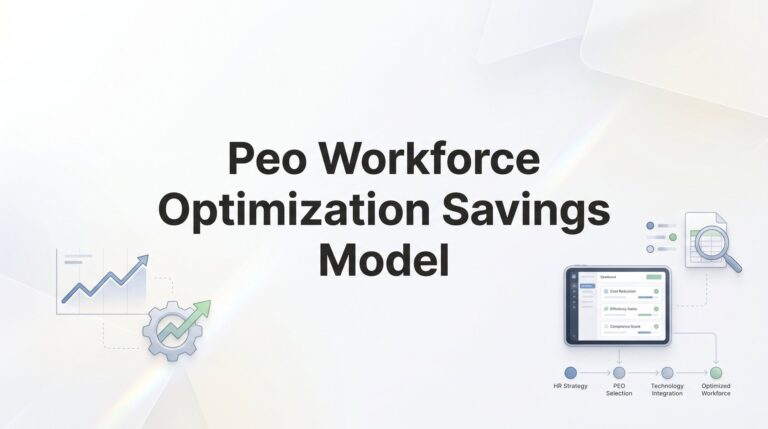
A practical PEO workforce optimization savings model helps business owners move beyond vague vendor claims by building their own framework to accurately calculate true PEO costs and savings. This guide covers compliance risk reduction, workforce performance factors, and opportunity cost recovery—giving you the structure needed to pressure-test any PEO’s savings projections against your specific situation.
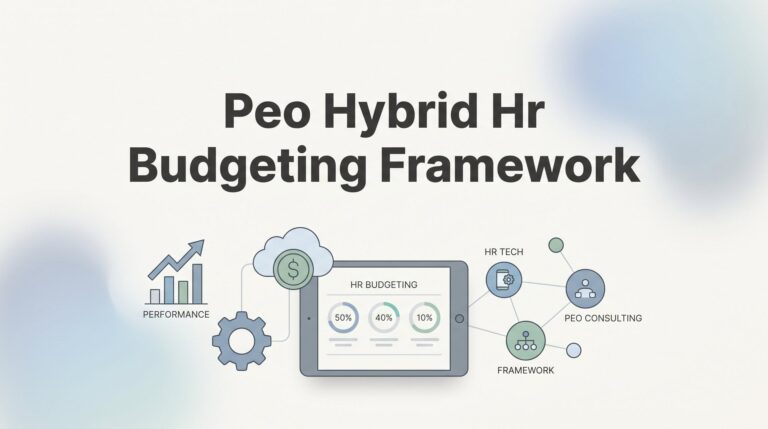
A PEO hybrid HR budgeting framework gives businesses a structured approach to tracking every HR dollar across both outsourced PEO services and internal HR functions, eliminating costly redundancies and budget blind spots. This guide outlines seven practical strategies to help companies clearly separate PEO fees from in-house costs, streamline renewal planning, and make smarter decisions about which HR functions to keep internal versus outsource.
The search starts the same way for a lot of leadership teams. Someone types peo near me into Google, opens a few…
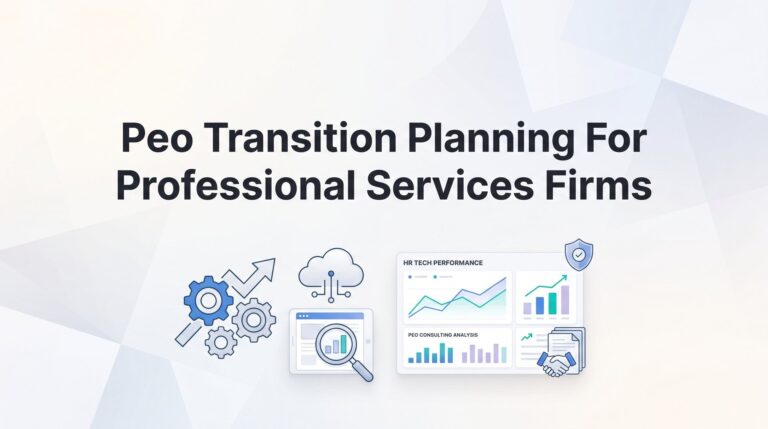
PEO transition planning for professional services firms requires a more complex, sequenced approach than standard businesses due to credentialed workforces, layered compensation structures, and client contracts tied to employer-of-record status. This step-by-step guide walks law practices, accounting firms, consulting groups, and similar organizations through the operational mechanics of switching PEO providers without disrupting payroll, creating benefits gaps, or triggering state licensing …
A PEO portfolio workforce cost model gives businesses with multiple PEO relationships a unified framework to map total labor spend across separate invoices, fee structures, benefit plans, and workers’ comp policies. This guide walks through how to consolidate fragmented cost data into a single view, enabling smarter decisions around hiring strategy, benefits benchmarking, vendor consolidation, and renewal negotiations.
A PEO workforce governance playbook helps business owners clearly define responsibilities, maintain control over employee data, and eliminate compliance blind spots that can create costly legal exposure in co-employment arrangements. This guide covers seven practical strategies to establish transparent oversight, protect your authority within the PEO relationship, and ensure your HR partnership works in your favor rather than against it.
A PEO financial governance ROI model helps businesses move beyond surface-level cost comparisons to systematically measure the true return on their PEO relationship, including tax remittance accuracy, compliance infrastructure, workers’ comp management, and multi-state exposure. Most companies rely on assumptions rather than data to evaluate PEO value—this framework provides the structure to quantify what the governance layer actually costs and delivers.